How to Calculate Elapsed Time: A Step-by-Step Guide With Examples
Learn how to calculate elapsed time between any two times by hand, including AM to PM, past midnight, several days, seconds and decimal hours.
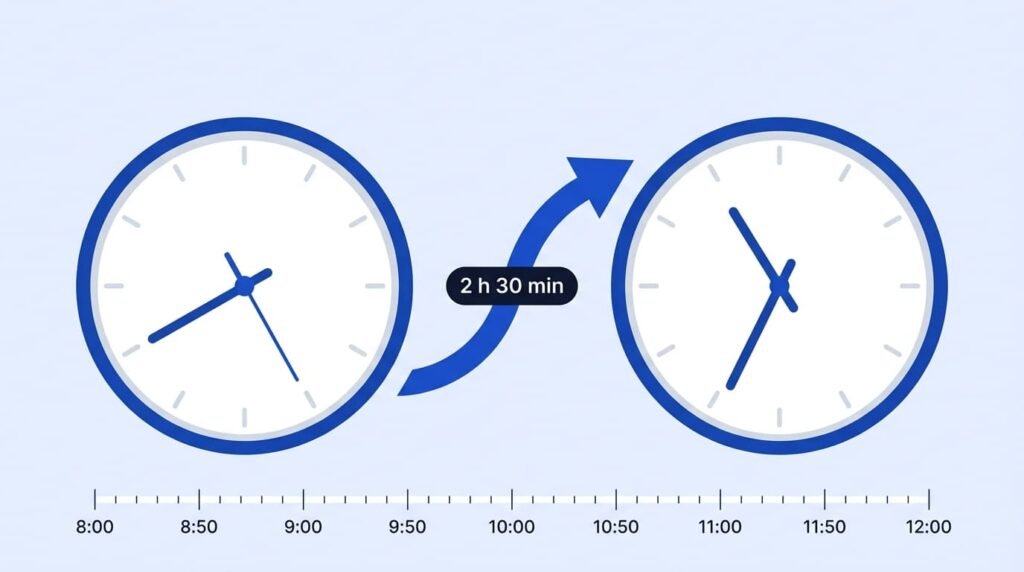
Knowing how to calculate elapsed time helps with everyday questions: how long a shift lasted, how long a flight takes, or how many hours a roast has been in the oven. Elapsed time is simply the amount of time that passes between a start time and an end time. The tricky part is that clocks count in sixties and twelves, not tens, so ordinary subtraction can give the wrong answer.
This guide shows you four reliable methods, then walks through the cases that usually trip people up: AM to PM, past midnight, several days, seconds, decimal hours, and daylight saving time. Every method comes with a worked example you can follow line by line.
What is elapsed time?
Elapsed time is the length of time between two moments. If a meeting starts at 2:15 PM and ends at 3:45 PM, the elapsed time is 1 hour 30 minutes. You might also see it called the duration, the time difference, or the time between two times.
It helps to keep two ideas apart:
- A clock time is a point in the day, such as 7:30 AM.
- An elapsed time is an amount of time, such as 7 hours 30 minutes.
Both are written with hours and minutes, which is exactly why people mix them up. A clock time tells you when; an elapsed time tells you how long.
The elapsed time formula
Every method in this guide rests on one formula:
Elapsed time = end time − start time
You can also rearrange it when you know the duration and need one of the clock times:
- End time = start time + elapsed time
- Start time = end time − elapsed time
The formula is simple. What makes time math different from regular math is how you regroup:
- 1 hour = 60 minutes, so you borrow or carry in groups of 60, not 10.
- 1 minute = 60 seconds.
- 1 day = 24 hours, and the 12-hour clock restarts at noon and at midnight.
Once you know how to calculate elapsed time with those three rules in mind, every example below follows the same pattern.
Method 1: Subtract hours and minutes (borrowing 60)
This is the fastest written way to learn how to calculate elapsed time when both times fall on the same side of noon. You line up the end time above the start time and subtract minutes, then hours.
- Write the end time on top and the start time underneath.
- Subtract the minutes. If the top minutes are smaller, borrow 1 hour from the top hours and add 60 to the top minutes.
- Subtract the hours.
- Write the answer as hours and minutes.
Example without borrowing
A class runs from 9:15 AM to 11:40 AM.
- Minutes: 40 − 15 = 25
- Hours: 11 − 9 = 2
The class lasts 2 hours 25 minutes.
Example with borrowing
A hike starts at 8:50 AM and ends at 11:20 AM. You can't take 50 minutes from 20 minutes, so you borrow an hour:
- 11:20 becomes 10 hours and 80 minutes (20 + 60 = 80).
- Minutes: 80 − 50 = 30
- Hours: 10 − 8 = 2
The hike takes 2 hours 30 minutes.
Notice what would happen without the time rule. Treating 11:20 and 8:50 as plain numbers gives 1120 − 850 = 270, which looks like "2:70". That is the most common mistake in time math: borrowing 100 instead of 60.
Method 2: Count up from the start time
Counting up is the method most teachers use, and it is great for mental math. Instead of subtracting, you jump forward from the start time in easy chunks until you reach the end time, then add the jumps. Many classrooms draw these jumps on a number line or a T-chart.
- Jump from the start time to the next whole hour.
- Jump in whole hours until you are as close to the end time as possible.
- Jump the remaining minutes to the end time.
- Add all the jumps together.
Example
A road trip leaves at 9:35 AM and arrives at 2:10 PM.
- 9:35 AM to 10:00 AM = 25 minutes
- 10:00 AM to 2:00 PM = 4 hours
- 2:00 PM to 2:10 PM = 10 minutes
Total: 4 hours + 25 minutes + 10 minutes = 4 hours 35 minutes.
Counting up handles the jump from AM to PM naturally, because you simply keep counting through noon. It also avoids borrowing entirely, which makes it the gentlest way to teach how to calculate elapsed time to children. If you are helping a child who is still learning to read the clock, our guide on teaching kids to tell time covers the basics first.
Method 3: Convert both times to minutes
It mirrors the way a spreadsheet or a computer works out a duration.
When you have awkward times or lots of calculations to do, the simplest way to calculate elapsed time is to turn everything into minutes after midnight. Then you only need ordinary subtraction.
- Convert each time to the 24-hour clock (see Method 4).
- Multiply the hours by 60 and add the minutes.
- Subtract the start total from the end total.
- Divide by 60. The whole number is the hours; the remainder is the minutes.
Example
A shift starts at 7:48 AM and ends at 4:05 PM.
- 7:48 AM = 7 × 60 + 48 = 468 minutes
- 4:05 PM = 16:05 = 16 × 60 + 5 = 965 minutes
- 965 − 468 = 497 minutes
- 497 ÷ 60 = 8 remainder 17
The shift lasts 8 hours 17 minutes. This method is also the easiest one to put into a spreadsheet or a bit of code, because computers handle a single number better than two separate units.
Method 4: Use the 24-hour clock for AM to PM
Subtracting across noon on a 12-hour clock gives nonsense: 3:25 PM minus 10:40 AM looks like "3 minus 10". The fix is to rewrite both times on the 24-hour clock, where the hours run from 0 to 23 and never restart at noon. This is how to calculate elapsed time when the start is in the morning and the end is in the afternoon or evening.
| 12-hour clock | 24-hour clock |
|---|---|
| 12:00 AM (midnight) | 00:00 |
| 1:00 AM to 11:59 AM | 01:00 to 11:59 (no change) |
| 12:00 PM (noon) | 12:00 |
| 1:00 PM | 13:00 |
| 6:30 PM | 18:30 |
| 11:59 PM | 23:59 |
The rule is short: for 1:00 PM to 11:59 PM, add 12 to the hour. For 12:xx AM, change the 12 to 00. Everything else stays the same. Our military time converter does this for any time, and the AM vs PM guide explains why 12 PM is noon.
Example
A store opens at 10:40 AM and closes at 3:25 PM.
- 3:25 PM becomes 15:25.
- Minutes: 25 is smaller than 40, so borrow: 15:25 becomes 14 hours 85 minutes.
- Minutes: 85 − 40 = 45
- Hours: 14 − 10 = 4
The store is open for 4 hours 45 minutes.
How to calculate elapsed time past midnight
When the end time is earlier on the clock than the start time, the period crosses midnight. Night shifts, overnight flights and sleep are the usual examples. You have two easy options.
Option A: Add 24 hours to the end time
A night shift runs from 10:45 PM to 7:15 AM.
- Start: 10:45 PM = 22:45
- End: 7:15 AM = 07:15. It is the next day, so add 24 hours: 31:15
- Minutes: borrow, so 31:15 becomes 30 hours 75 minutes. 75 − 45 = 30
- Hours: 30 − 22 = 8
The shift lasts 8 hours 30 minutes.
Option B: Split the time at midnight
Count from the start time to midnight, then from midnight to the end time.
- 10:45 PM to 12:00 AM = 1 hour 15 minutes
- 12:00 AM to 7:15 AM = 7 hours 15 minutes
- Total = 8 hours 30 minutes
Both options give the same answer. Splitting at midnight is easier to do in your head; adding 24 is easier on paper or in a spreadsheet.
Elapsed time over several days
Knowing how to calculate elapsed time over several days matters for shipping, travel and hospital stays. Count whole days first, then the leftover hours and minutes. A shipment leaves on Friday at 3:30 PM and arrives on Monday at 9:10 AM.
- Count whole days from the start time: Friday 3:30 PM to Sunday 3:30 PM is 2 days. One more day would pass Monday 9:10 AM, so stop at 2.
- Count the rest: Sunday 3:30 PM to midnight is 8 hours 30 minutes, and midnight to Monday 9:10 AM is 9 hours 10 minutes. Together that is 17 hours 40 minutes.
- Combine: 2 days 17 hours 40 minutes.
To express it in hours only, multiply the days by 24 and add the hours: 2 × 24 + 17 = 65 hours 40 minutes. Our time duration calculator accepts dates as well as times, so it can check spans of days, weeks or months for you.
Elapsed time with seconds
Races, lab experiments and cooking timers often need seconds. Here is how to calculate elapsed time with seconds: the method is the same, with one extra column. Borrow 60 seconds from the minutes when you need to, just as you borrow 60 minutes from the hours.
A runner starts at 10:58:47 and finishes at 11:34:12.
- Seconds: 12 is smaller than 47, so borrow 1 minute: 11:34:12 becomes 11:33:72. Then 72 − 47 = 25 seconds.
- Minutes: 33 is smaller than 58, so borrow 1 hour: 11:33 becomes 10:93. Then 93 − 58 = 35 minutes.
- Hours: 10 − 10 = 0.
The run took 35 minutes 25 seconds. To time something live instead, use the online stopwatch.
Turn elapsed time into decimal hours
Once you know how to calculate elapsed time in hours and minutes, payroll is one step away. Payroll systems and timesheets usually want hours as a decimal, such as 7.5 instead of 7:30. Keep the whole hours and divide the minutes by 60.
- 7 hours 30 minutes = 7 + 30 ÷ 60 = 7.5 hours
- 6 hours 45 minutes = 6 + 45 ÷ 60 = 6.75 hours
- 7 hours 20 minutes = 7 + 20 ÷ 60 = 7.33 hours (rounded)
| Minutes | Decimal | Minutes | Decimal |
|---|---|---|---|
| 6 min | 0.1 | 36 min | 0.6 |
| 12 min | 0.2 | 42 min | 0.7 |
| 15 min | 0.25 | 45 min | 0.75 |
| 18 min | 0.3 | 48 min | 0.8 |
| 20 min | 0.33 | 50 min | 0.83 |
| 24 min | 0.4 | 54 min | 0.9 |
| 30 min | 0.5 | 60 min | 1.0 |
Be careful not to read a decimal as a clock time. 2.5 hours is 2 hours 30 minutes, not 2 hours 50 minutes. For any value, the time to decimal converter works in both directions, and the hours calculator totals a full week of shifts with breaks.
Work backward: find the start or end time
Sometimes you know the duration and need a clock time. Use the rearranged formula.
Find the end time (add)
A movie starts at 7:40 PM and runs for 2 hours 35 minutes.
- Add the hours: 7 + 2 = 9
- Add the minutes: 40 + 35 = 75. That is more than 60, so carry 1 hour: 75 minutes = 1 hour 15 minutes.
- Result: 9:75 becomes 10:15
The movie ends at 10:15 PM.
Find the start time (subtract)
You need to arrive at 9:00 AM, and the drive takes 1 hour 50 minutes.
- Borrow: 9:00 becomes 8 hours 60 minutes.
- Minutes: 60 − 50 = 10
- Hours: 8 − 1 = 7
Leave by 7:10 AM. The time calculator adds or subtracts any number of days, hours and minutes, and the hours from now and hours ago tools do the same from the current time.
Add up several durations
To total a week of workouts or a list of tasks, add all the minutes and all the hours separately, then convert the extra minutes into hours.
Five workouts last 45 min, 1 h 20 min, 55 min, 1 h 35 min and 50 min.
- Minutes: 45 + 20 + 55 + 35 + 50 = 205 minutes
- Hours: 1 + 1 = 2 hours
- 205 minutes = 3 hours 25 minutes (205 ÷ 60 = 3 remainder 25)
- Total: 2 hours + 3 hours 25 minutes = 5 hours 25 minutes
Multiply and divide time
Multiplying or dividing hours and minutes directly causes errors, so convert to a single unit first.
Multiply
A swimmer averages 3 minutes 45 seconds per lap and swims 7 laps.
- 3 min 45 s = 225 seconds
- 225 × 7 = 1,575 seconds
- 1,575 ÷ 60 = 26 remainder 15
Total: 26 minutes 15 seconds.
Divide
You split 8 hours 35 minutes of work evenly across 5 people.
- 8 h 35 min = 8 × 60 + 35 = 515 minutes
- 515 ÷ 5 = 103 minutes
- 103 minutes = 1 hour 43 minutes
Each person works 1 hour 43 minutes.
Daylight saving time and time zones
Two situations make the clock lie about how much time really passed, even when you know exactly how to calculate elapsed time.
Daylight saving time
On the night the clocks spring forward, an hour disappears. If you go to bed at 11:00 PM on Saturday and wake at 7:00 AM on Sunday, the clock suggests 8 hours of sleep, but only 7 hours actually passed. On the night the clocks fall back, the same clock times give you 9 hours. In the United States the clocks change at 2:00 AM, so any span that includes 2:00 AM on those two nights is an hour shorter or longer than the simple subtraction says. Our daylight saving time guide explains when and why this happens, and the daylight saving time page shows the next change.
Time zones
If the start and end times are in different time zones, convert both to the same zone before subtracting. A flight leaves New York at 6:00 PM Eastern Time and lands in Los Angeles at 9:10 PM Pacific Time. Subtracting the clock times gives 3 hours 10 minutes, which is wrong. Los Angeles is 3 hours behind New York, so 9:10 PM Pacific is 12:10 AM Eastern. The real flight time is 6 hours 10 minutes. The time zone converter does the conversion for any pair of places.
Common mistakes to avoid
Most errors in elapsed time come from a handful of habits. Watch for these whenever you calculate elapsed time by hand.
- Borrowing 100 instead of 60. 11:20 minus 8:50 is 2 hours 30 minutes, not "2:70".
- Subtracting across noon on a 12-hour clock. Convert PM times to the 24-hour clock first, or count up through noon.
- Getting a negative answer. If the end time is earlier than the start time, the period crosses midnight. Add 24 hours to the end time.
- Mixing up 12 AM and 12 PM. 12 AM is midnight and 12 PM is noon, so 12 AM to 12 PM is 12 hours, not zero.
- Reading decimals as minutes. 1.5 hours is 1 hour 30 minutes, and 0.3 hours is 18 minutes.
- Counting the hours on your fingers. From 9 to 12 you say "9, 10, 11, 12" and count four, but only 3 hours pass. Count the jumps between the hours, not the hours themselves.
- Ignoring clock changes and time zones. Check both before trusting the answer for travel and overnight work.
How to check your answer
Checking your work is a quick but important part of learning how to calculate elapsed time correctly. The quickest check is to work backward. Add your elapsed time to the start time; you should land exactly on the end time. For the night shift example, 10:45 PM plus 8 hours is 6:45 AM, and plus 30 minutes is 7:15 AM, which matches.
A second check is to estimate. Round both times to the nearest hour and subtract. If your exact answer is far from the estimate, something went wrong, usually a borrowing step or an AM/PM mix-up.
Which method should you use?
| Situation | Best method |
|---|---|
| Both times in the morning or both in the afternoon | Subtract hours and minutes (Method 1) |
| Mental math, or teaching children | Count up (Method 2) |
| Awkward times, many calculations, spreadsheets | Convert to minutes (Method 3) |
| AM start and PM end | 24-hour clock (Method 4) or count up |
| Overnight | Add 24 hours, or split at midnight |
| Several days | Whole days first, then hours and minutes |
Whichever method you choose, the steps for how to calculate elapsed time stay the same: line up the units, regroup in sixties, and watch for noon, midnight and clock changes.
Practice problems
Try these, then check your answers below.
- A meeting runs from 8:25 AM to 12:10 PM. How long is it?
- A movie plays from 1:50 PM to 6:05 PM. How long is it?
- You sleep from 9:40 PM to 5:20 AM. How long do you sleep?
- A 2 hour 50 minute hike ends at 1:15 PM. When did it start?
- You practice piano four times for 1 hour 25 minutes each. What is the total?
- A train leaves Monday at 11:00 PM and arrives Wednesday at 6:30 AM. How long is the trip?
Answers
- 3 hours 45 minutes. 12:10 becomes 11:70, then 11:70 − 8:25 = 3:45.
- 4 hours 15 minutes. 1:50 PM becomes 13:50 and 6:05 PM becomes 18:05. Borrow to get 17:65, then 17:65 − 13:50 = 4:15.
- 7 hours 40 minutes. 2 hours 20 minutes to midnight, plus 5 hours 20 minutes after it.
- 10:25 AM. 13:15 becomes 12:75, then 12:75 − 2:50 = 10:25.
- 5 hours 40 minutes. 85 minutes × 4 = 340 minutes, and 340 ÷ 60 = 5 remainder 40.
- 1 day 7 hours 30 minutes, or 31 hours 30 minutes. Monday 11:00 PM to Tuesday 11:00 PM is 1 day, and then 7 hours 30 minutes more.
When to use a calculator instead
Learning how to calculate elapsed time by hand is worth it, because it is the best way to understand what the numbers mean. For real work, a calculator saves time and removes the risk of a borrowing slip. Use the time duration calculator to find the time between two times or dates, the hours calculator for timesheets with breaks, and the time calculator to add or subtract hours and minutes. Each one handles AM and PM, midnight and daylight saving time automatically.
Frequently asked questions
What is the formula for elapsed time?
Elapsed time = end time − start time. Subtract minutes from minutes and hours from hours, borrowing 60 minutes from the hours when the end minutes are smaller. If the period crosses midnight, add 24 hours to the end time before you subtract.
How do you calculate elapsed time from AM to PM?
Convert the PM time to the 24-hour clock by adding 12 to the hour, then subtract as usual. For example, 9:30 AM to 2:45 PM becomes 14:45 − 9:30 = 5 hours 15 minutes. You can also count up to noon and then on to the end time.
How do you calculate elapsed time across midnight?
Add 24 hours to the end time, or split the period at midnight. From 11:30 PM to 6:00 AM, count 30 minutes to midnight and 6 hours after it, for a total of 6 hours 30 minutes.
How do I calculate elapsed time in Excel?
Put the start time in A2 and the end time in B2, then use =MOD(B2-A2,1) and format the cell as [h]:mm. MOD handles shifts that cross midnight. To get decimal hours instead, use =MOD(B2-A2,1)*24 and format the cell as a number.
How many hours is 9 AM to 5 PM?
8 hours. 5 PM is 17:00 on the 24-hour clock, and 17 − 9 = 8. If you take an unpaid 30-minute lunch, you work 7 hours 30 minutes, or 7.5 hours.
Is elapsed time the same as duration?
Yes. Elapsed time, duration and time difference all mean the amount of time between a start and an end. A clock time, by contrast, is a single point in the day.
By the TimeNowTools team · Last reviewed 20 October 2026