How to Calculate Paid Time Off (PTO Accrual) With Examples
Divide the yearly PTO allowance by work hours or pay periods to get the accrual rate. Tables, examples, caps and payout.
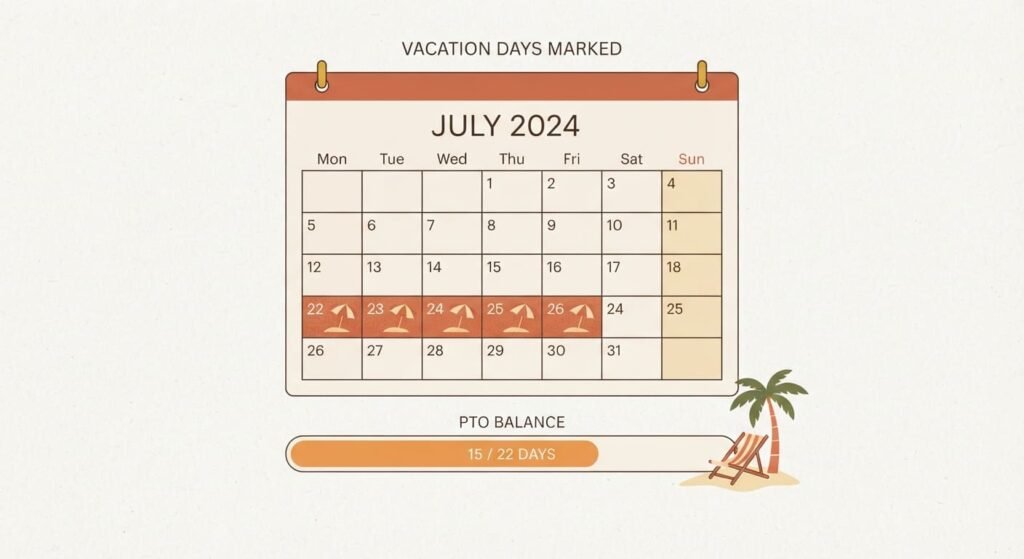
If you want to know how to calculate paid time off (PTO), the key number is the accrual rate: the PTO hours you earn per hour worked or per pay period. Divide the yearly PTO allowance by the hours (or pay periods) in a year. With 120 hours of PTO a year and a 2,080-hour work year, you earn 0.0577 hours of PTO for every hour worked, or 4.62 hours every two weeks. This guide shows each method with worked examples, plus caps, carryover and part-time cases.
Step 1: Turn the allowance into hours
PTO is often promised in days, so convert it to hours first: days × hours in a normal workday. 15 days at 8 hours a day = 120 hours. 20 days at 7.5 hours = 150 hours.
Method 1: Accrual per hour worked
Common for hourly and part-time employees, because PTO grows with the hours actually worked.
Accrual rate = yearly PTO hours ÷ yearly work hours.
120 ÷ 2,080 = 0.0577 hours of PTO per hour worked. In a week where someone works 32 hours, they earn 32 × 0.0577 = 1.85 hours of PTO.
A rate is often written as "1 hour of PTO for every X hours worked". 2,080 ÷ 120 = 17.33, so 0.0577 is about 1 hour for every 17.3 hours worked.
Method 2: Accrual per pay period
Common for salaried employees: the same amount is added each paycheck.
Per period = yearly PTO hours ÷ pay periods per year.
| Pay schedule | Periods | 80 h a year | 120 h a year | 160 h a year |
|---|---|---|---|---|
| Weekly | 52 | 1.54 | 2.31 | 3.08 |
| Biweekly | 26 | 3.08 | 4.62 | 6.15 |
| Semimonthly | 24 | 3.33 | 5.00 | 6.67 |
| Monthly | 12 | 6.67 | 10.00 | 13.33 |
Hours of PTO earned per pay period. 80 hours is 10 days, 120 hours is 15 days and 160 hours is 20 days at 8 hours a day.
Method 3: Annual lump sum
Some employers give the whole year's PTO on 1 January or on the work anniversary. There is nothing to calculate during the year, but new hires often get a prorated amount: someone starting on 1 July with a 120-hour policy might get 60 hours for the first year.
Worked examples
Full-time, biweekly
Priya gets 15 days (120 hours) a year and is paid every two weeks. She earns 120 ÷ 26 = 4.62 hours per paycheck. After 10 paychecks she has 46.2 hours, about 5.8 days.
Part-time, per hour worked
Ben works 25 hours a week. His employer uses the same 0.0577 rate as full-timers. Over a year: 25 × 52 × 0.0577 = 75 hours, which is 62.5% of the full-time 120 hours, the same proportion as his hours (25 ÷ 40).
How long to earn a day off
At 0.0577 hours per hour worked, an 8-hour day of PTO takes 8 ÷ 0.0577 = about 139 hours of work, or roughly 3.5 weeks at 40 hours a week.
Which work hours to divide by
2,080 (40 × 52) is the most common denominator, but some employers use 2,000 or subtract holidays and the PTO itself, because you do not accrue PTO while you are on PTO. Dividing by a smaller number gives a slightly higher rate, so everyone still reaches the full allowance. Whatever you use, write it in the policy and apply it the same way to everyone.
Caps, carryover and payout
- Accrual cap: many policies stop accrual at a maximum balance, such as 1.5 times the yearly allowance. Once you reach it, you earn nothing more until you use some.
- Carryover: some policies let unused PTO roll into the next year, sometimes up to a limit; others use "use it or lose it".
- Payout: some US states, including California, treat earned vacation as wages that must be paid out when employment ends and do not allow "use it or lose it" for vacation. Check your state's rules.
- Sick leave: many states and cities require paid sick leave, often at 1 hour for every 30 hours worked. That can be separate from, or part of, a PTO policy.
PTO accrual rates by allowance
This table shows how to calculate paid time off rates for common allowances, using a 2,080-hour year.
| Days a year | Hours a year | Per hour worked | 1 hour per | Per biweekly check |
|---|---|---|---|---|
| 5 days | 40 | 0.0192 | 52 h | 1.54 |
| 10 days | 80 | 0.0385 | 26 h | 3.08 |
| 12 days | 96 | 0.0462 | 21.7 h | 3.69 |
| 15 days | 120 | 0.0577 | 17.3 h | 4.62 |
| 18 days | 144 | 0.0692 | 14.4 h | 5.54 |
| 20 days | 160 | 0.0769 | 13 h | 6.15 |
| 25 days | 200 | 0.0962 | 10.4 h | 7.69 |
| 30 days | 240 | 0.1154 | 8.7 h | 9.23 |
Tracking a PTO balance
A balance is simple bookkeeping: starting balance + hours earned − hours used. Here is a quarter for an employee who earns 4.62 hours per biweekly paycheck.
| Paycheck | Earned | Used | Balance |
|---|---|---|---|
| Start | 20.00 | ||
| 1 | 4.62 | 0 | 24.62 |
| 2 | 4.62 | 8 | 21.24 |
| 3 | 4.62 | 0 | 25.86 |
| 4 | 4.62 | 0 | 30.48 |
| 5 | 4.62 | 16 | 19.10 |
| 6 | 4.62 | 0 | 23.72 |
Keep at least two decimal places. Rounding every paycheck to whole hours can add or remove several hours over a year.
How an accrual cap works
Suppose the policy caps the balance at 180 hours (1.5 × 120). An employee with 177 hours earns 4.62 hours on the next paycheck, but only 3 hours are added, bringing the balance to 180. Nothing more accrues until they take time off. Caps encourage people to rest and limit how much the employer owes, so check your balance before it stops growing.
Calculating PTO payout
Where unused PTO is paid out at the end of employment, multiply the balance by the hourly rate. For salaried staff, the hourly rate is the annual salary ÷ 2,080.
- Balance: 62.5 hours
- Salary: $58,240 a year, so $58,240 ÷ 2,080 = $28 an hour
- Payout: 62.5 × $28 = $1,750 before taxes
Payouts are usually taxed as supplemental wages, so the take-home amount is lower.
Front-loading vs accrual
Front-loading gives the full year's PTO on day one; accrual builds it up over time. Front-loading is simpler and lets new staff take a holiday early, but if someone leaves after using all of it, the employer may have paid for leave that was not yet earned. Accrual is fairer to both sides and is how most employers handle how to calculate paid time off for hourly staff. Some use a mix: front-load sick leave and accrue vacation.
PTO by years of service
Many policies increase PTO with tenure. A common pattern:
- Years 0 to 2: 10 days (80 hours), 3.08 hours per biweekly check
- Years 3 to 5: 15 days (120 hours), 4.62 hours per check
- Years 6 and up: 20 days (160 hours), 6.15 hours per check
When someone moves up a tier partway through the year, apply the new rate from the anniversary date onward.
Common mistakes
- Accruing on overtime hours when the policy only counts regular hours, or the reverse.
- Rounding each paycheck, which drifts over the year.
- Mixing hours and days in the same balance.
- Forgetting the cap and promising time off that never accrued.
- Using a denominator that never reaches the full allowance for people who take all their PTO.
Tracking hours for accrual
Per-hour accrual only works if hours are recorded accurately. Use actual start and end times minus unpaid breaks, and convert minutes to decimals before multiplying. See how to calculate work hours, or total a week with the hours calculator. Turning PTO hours into days and weeks is covered in our hours to days conversion guide.
This guide explains common methods and is not legal advice. PTO and paid sick leave rules vary by state and city.
How to calculate paid time off for part-time staff
Per-hour accrual keeps part-time PTO fair without extra rules. Using a 10-day (80-hour) policy, the rate is 80 ÷ 2,080 = 0.0385 hours per hour worked:
- 20 hours a week: 20 × 52 × 0.0385 = about 40 hours a year, half the full-time amount.
- 30 hours a week: 30 × 52 × 0.0385 = about 60 hours a year.
Some employers prefer to prorate a fixed allowance instead: a 0.6 FTE employee gets 60% of the full-time PTO, credited per paycheck. Both methods give the same yearly total when hours are steady.
How to calculate paid time off for a new hire
With a lump-sum policy, prorate the first year by the months remaining. Someone who starts on 1 March under a 120-hour policy has 10 of 12 months left, so they get 120 × 10 ÷ 12 = 100 hours. With accrual, there is nothing to prorate: they simply start earning from their first paycheck. Some policies add a waiting period, such as 90 days, before new staff can use what they have earned.
PTO for 10-hour and 12-hour shifts
PTO is tracked in hours because days are not all the same length. Someone on four 10-hour days uses 10 hours of PTO for a day off, so a 120-hour balance covers 12 days off, not 15. A nurse on 12-hour shifts uses 12 hours per shift, so 120 hours covers 10 shifts. When you explain how to calculate paid time off to staff on long shifts, show the balance in their own shift lengths to avoid surprises.
Paid sick leave alongside PTO
Many US states and cities require paid sick leave, often at 1 hour for every 30 hours worked. A part-time employee working 1,040 hours a year would earn about 34.7 hours under that rule. A combined PTO policy can satisfy these laws, but only if it accrues at least as fast and allows the same uses. Check the rules where each employee works, since remote staff may be covered by a different state's law.
Holidays are usually separate
Paid company holidays, such as New Year's Day or Thanksgiving, are normally not taken from PTO. A policy might give 15 days of PTO plus 10 paid holidays: 25 paid days off in total. When you compare job offers, add both numbers together.
What your PTO is worth
PTO is part of your pay. Multiply the yearly hours by your hourly rate: 120 hours at $25 an hour is worth $3,000 a year. That makes it easier to compare an offer of $62,000 with 10 days off against $60,000 with 20 days off: the extra 80 hours at about $28.85 an hour are worth around $2,300.
How to calculate paid time off in a spreadsheet
Use one row per pay period with columns for hours worked (B), PTO earned (C), PTO used (D) and balance (E):
- Earned per period, per-hour method:
=B2*0.0577 - Earned per period, fixed method:
=120/26 - Running balance:
=E1+C2-D2 - Balance with a 180-hour cap:
=MIN(180,E1+C2)-D2
That small sheet covers everything in this guide on how to calculate paid time off. For converting the balance into days and weeks, divide by the hours in a normal workday.
How to calculate paid time off when your hours change
If you move from part time to full time partway through the year, apply the accrual rate to the hours in each period. At 0.0577 hours per hour worked, 26 weeks at 20 hours earns 520 × 0.0577 = 30 hours, and 26 weeks at 40 hours earns 1,040 × 0.0577 = 60 hours. The year's total is 90 hours. With per-paycheck accrual, the employer switches to the full-time amount from the first paycheck after the change.
PTO hours to days
| PTO hours | 8-hour days | Weeks (40 h) |
|---|---|---|
| 40 | 5 | 1 |
| 80 | 10 | 2 |
| 100 | 12.5 | 2.5 |
| 120 | 15 | 3 |
| 160 | 20 | 4 |
| 200 | 25 | 5 |
Unlimited PTO
Under an unlimited PTO policy, there is no accrual and usually no balance to pay out when someone leaves. You do not need to know how to calculate paid time off in the usual sense, but it is still wise to record the days taken. Some studies and surveys suggest people with unlimited PTO take fewer days off than those with a fixed allowance, and records help managers make sure everyone actually rests.
Quick checklist
- Convert the allowance to hours.
- Choose per hour worked, per pay period or lump sum.
- Divide by 2,080 hours or by the number of pay periods.
- Keep two decimal places and apply any cap.
- Add earned hours, subtract used hours, and check the balance each paycheck.
Follow those five steps and you know how to calculate paid time off for any schedule.
Worked example: a full year of PTO
Here is how to calculate paid time off from start to finish for one employee. Maria earns 15 days (120 hours) a year, accrued per biweekly paycheck, with a 180-hour cap and 40 hours carried over from last year.
- Accrual per paycheck: 120 ÷ 26 = 4.62 hours.
- Starting balance: 40 hours.
- Earned over the year: 26 × 4.62 = 120 hours (rounded).
- Used: a one-week vacation in July (40 hours), three sick days (24 hours) and a long weekend in October (8 hours), 72 hours in total.
- Ending balance: 40 + 120 − 72 = 88 hours, or 11 days.
Maria never came close to the 180-hour cap, so none of her accrual was lost. If her employer only allows 40 hours to carry over, she would lose 48 hours at year end unless she uses them, which is worth planning for in the autumn. Checking the balance on each paystub, with the formulas above, makes sure the numbers match.
Frequently asked questions
How do you calculate paid time off?
Convert the yearly allowance to hours, then divide it by yearly work hours (for per-hour accrual) or by the number of pay periods (for per-paycheck accrual). 120 hours a year is 0.0577 hours per hour worked, or 4.62 hours every two weeks.
How much PTO do you get per hour worked?
It depends on the allowance. 80 hours a year is 0.0385 per hour worked, 120 hours is 0.0577 and 160 hours is 0.0769, using a 2,080-hour year.
How many hours of PTO is 2 weeks?
80 hours for a full-time employee working 8-hour days, 5 days a week.
Do part-time employees accrue PTO?
Often yes, at the same per-hour rate, so they earn PTO in proportion to the hours they work. Many states also require paid sick leave for part-time workers.
How do you calculate paid time off per paycheck?
Divide the yearly PTO hours by the number of paychecks. 120 hours over 26 biweekly paychecks is 4.62 hours per paycheck; over 24 semimonthly paychecks it is 5 hours.
How many hours of PTO do you earn per week?
Divide the yearly hours by 52. 80 hours a year is 1.54 hours a week, 120 hours is 2.31 and 160 hours is 3.08.
How many days is 120 hours of PTO?
15 days at 8 hours a day, or 3 full working weeks. On 10-hour days it is 12 days.
By the TimeNowTools team · Last reviewed 23 October 2026