How to Read a Clock: A Step-by-Step Guide
Read the short hand for the hour, the long hand for the minutes, then put them together. Examples, tricky cases and practice.
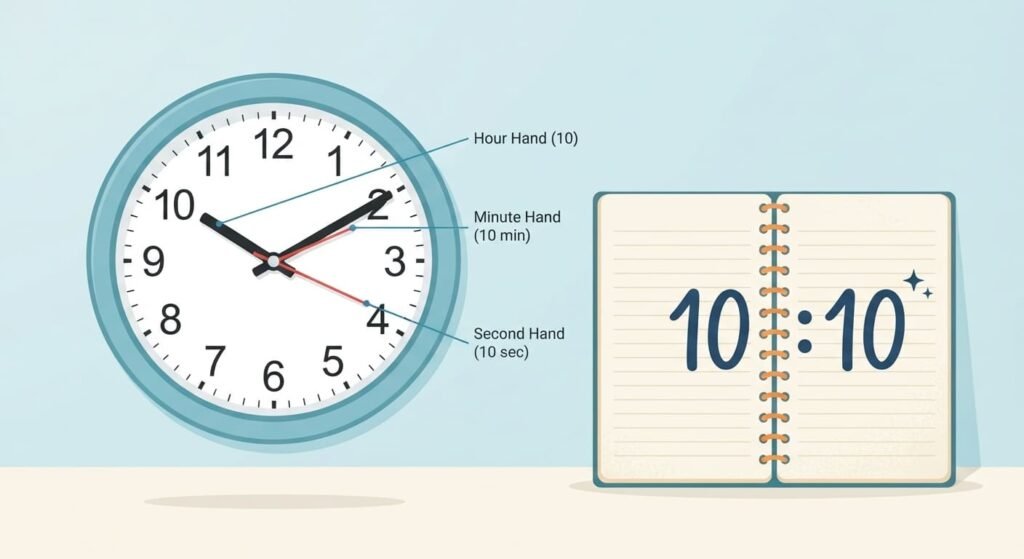
Learning how to read a clock takes three steps: read the short hand for the hour, read the long hand for the minutes, then put the two together. When the short hand points just past the 4 and the long hand points at the 3, the time is 4:15, or quarter past four. This guide walks through each step with examples, covers the tricky cases (times just before the hour, clocks with Roman numerals or no numbers, and watches), and ends with practice questions you can check yourself.
What you see on a clock face
Before you can read the time, it helps to know the parts of an analog clock:
- The numbers 1 to 12 around the edge. They stand for hours when you read the short hand.
- 60 small marks between the numbers, one for each minute. There are 4 small marks between each pair of numbers, plus the mark at each number, which makes 5 minutes per number.
- The hour hand: the short, thick hand.
- The minute hand: the long hand.
- The second hand: a thin hand that sweeps round once every minute. Many clocks do not have one.
All the hands turn the same way, which is why we call it "clockwise": from 12 to 1 to 2, round to 12 again. For a labelled picture of each part, see our guide to teaching kids to tell time.
Step 1: Read the hour hand
The hour hand moves slowly. It takes 12 hours to go all the way round, so in one hour it only moves from one number to the next.
The rule is simple: the hour is the last number the short hand has passed. If it points exactly at 9, the hour is 9. If it is between 9 and 10, the hour is still 9, because it has not reached 10 yet.
This is the single most important idea in how to read a clock. Most mistakes happen when the hour hand is close to the next number, so we will come back to it below.
Step 2: Read the minute hand
The minute hand goes round once every hour. Each number it points to is worth 5 minutes, so you count in fives from the 12:
| Long hand points to | Minutes |
|---|---|
| 12 | 0 (o'clock) |
| 1 | 5 |
| 2 | 10 |
| 3 | 15 |
| 4 | 20 |
| 5 | 25 |
| 6 | 30 |
| 7 | 35 |
| 8 | 40 |
| 9 | 45 |
| 10 | 50 |
| 11 | 55 |
A quick trick: multiply the number by 5. If the long hand points at 8, that is 8 × 5 = 40 minutes.
Reading minutes between the numbers
When the long hand is between two numbers, count the small marks. Start from the number just before it and add one minute per mark. If the long hand is 2 marks past the 4, that is 20 + 2 = 22 minutes.
Step 3: Put the hour and minutes together
Write the hour, a colon, then the minutes as two digits. Hour 7 and 5 minutes is written 7:05, not 7:5.
Example: the short hand is between 2 and 3, and the long hand points at the 9. The hour is 2 and the minutes are 9 × 5 = 45, so the time is 2:45.
That is all there is to how to read a clock in its simplest form. The rest of this guide covers the ways people say the time and the cases that trip people up.
Saying the time: o'clock, half past and quarter
People rarely say "two forty-five" out loud in everyday British English; they often say "quarter to three". In American English, both "two forty-five" and "quarter to three" are common. These are the main patterns:
| Long hand on | Digital | Words |
|---|---|---|
| 12 | 3:00 | three o'clock |
| 3 | 3:15 | quarter past three |
| 6 | 3:30 | half past three |
| 9 | 3:45 | quarter to four |
| 2 | 3:10 | ten past three |
| 10 | 3:50 | ten to four |
"Past" and "to"
For the first half of the hour (the right side of the clock, from 12 down to 6), we say minutes past the current hour. For the second half (the left side, from 6 back up to 12), we say minutes to the next hour. To find "to" times, count backwards from the 12: if the long hand is on the 8, there are 20 minutes to go, so 3:40 is "twenty to four".
Notice that "quarter to four" is 3:45, not 4:45. The clock is still in the 3 o'clock hour; it is a quarter of an hour before 4.
The tricky part: times just before the hour
At 2:55, the hour hand is almost touching the 3. It is tempting to read it as 3, but it is still 2 until the long hand reaches the 12. The fix is to read the minute hand first when the hour hand is close to a number:
- If the long hand is on the left side of the clock (past the 6), the hour is the number the short hand is approaching minus one. In other words, the number it has just passed.
- If the long hand is on the right side (before the 6), the hour is the number the short hand has just passed, and it will be close to that number.
Example: the short hand is very close to the 6 and the long hand is on the 11. The long hand says 55 minutes, which means the hour is almost over, so the time is 5:55, not 6:55.
Once you understand this, you know how to read a clock at any time of day without second-guessing.
Reading the second hand
The second hand works like the minute hand: each number is 5 seconds, and each small mark is 1 second. It goes round once every minute. You rarely need to read seconds, but they are useful for timing short things, such as a pulse or a 30-second exercise. For precise timing, a stopwatch is easier.
AM, PM and the 24-hour clock
An analog clock only shows 12 hours, so the hands look the same at 7:00 in the morning and 7:00 in the evening. You know which one it is from the day around you. When writing the time, add AM for times from midnight to just before noon, and PM from noon to just before midnight. Our guide to AM vs PM explains noon and midnight in detail.
Digital clocks and timetables often use 24-hour time instead. Afternoon hours carry on counting past 12: 1:00 PM is 13:00, and 7:30 PM is 19:30. The military time converter turns any 24-hour time into AM and PM.
Clocks with Roman numerals
Many classic clocks use Roman numerals. Read them exactly the same way; you only need to know the symbols:
| I = 1 | II = 2 | III = 3 | IIII or IV = 4 |
| V = 5 | VI = 6 | VII = 7 | VIII = 8 |
| IX = 9 | X = 10 | XI = 11 | XII = 12 |
Most clock faces write 4 as IIII rather than IV. It is a long-standing clockmaking tradition and makes the dial look balanced opposite the VIII.
Clocks with no numbers
Minimalist clocks and many watches have only lines, or nothing at all. The positions do not change: 12 is always at the top, 3 on the right, 6 at the bottom and 9 on the left. Picture the four quarters first, then fill in the numbers between them. With a little practice, knowing how to read a clock without numbers becomes automatic, because you start to recognise the angle of the hands rather than reading digits.
How to read a watch
An analog watch is just a small clock, so the same three steps apply. Two extras can help:
- The crown (the small knob on the side) is usually at the 3 position, so it tells you which way is up.
- The date window on many watches shows the day of the month, often near the 3 or the 6.
Some watches have extra small dials (sub-dials) for a stopwatch or seconds. Ignore those at first and read only the two main hands.
Practice: read these times
Cover the answer column and try each one. They are written as you would describe the hands.
| Short hand | Long hand | Answer |
|---|---|---|
| On the 8 | On the 12 | 8:00, eight o'clock |
| Halfway between 11 and 12 | On the 6 | 11:30, half past eleven |
| Just past the 1 | On the 3 | 1:15, quarter past one |
| Nearly on the 10 | On the 9 | 9:45, quarter to ten |
| Just past the 6 | On the 4 | 6:20, twenty past six |
| Nearly on the 3 | On the 11 | 2:55, five to three |
| Just past the 12 | 2 marks past the 1 | 12:07, seven minutes past twelve |
| A little past halfway from 4 to 5 | On the 7 | 4:35, twenty-five to five |
For unlimited practice, the learn to tell time tool shows random clocks at the level you choose, lets you drag the hands to set a time, and prints worksheets with answers.
How to read a clock to the exact minute: three worked examples
Here is how to read a clock when the long hand is not on a number, thinking aloud through each step.
Example 1: 8:23
The short hand is a little way past the 8, so the hour is 8. The long hand is 3 small marks past the 4. The 4 is worth 20 minutes, plus 3 marks makes 23. The time is 8:23, or twenty-three minutes past eight.
Example 2: 11:52
The short hand is very close to the 12, so read the long hand first. It is 2 marks past the 10: 50 + 2 = 52 minutes. Because the minutes are past 30, the hour hand is approaching the next number but has not reached it, so the hour is 11. The time is 11:52, or eight minutes to twelve.
Example 3: 6:38
The long hand is 3 marks past the 7: 35 + 3 = 38 minutes. The short hand is a little past halfway between 6 and 7, which matches 38 minutes past 6. The time is 6:38, or twenty-two minutes to seven.
Notice how the position of the short hand always agrees with the minutes. At half past, it sits halfway between two numbers; at quarter to, it is three quarters of the way. Using this as a check is one of the best habits when you are still learning how to read a clock.
Analog or digital: when each is easier
A digital clock tells you the exact time at a glance, which is why it is common on phones and ovens. An analog clock shows something a digital clock cannot: how much of the hour has passed and how much is left. If a meeting ends at 3:00 and the long hand is on the 9, you can see a quarter of the hour remains without doing any maths. That is why classrooms, exam halls and kitchens still use analog clocks, and why knowing how to read a clock is still worth the effort.
A one-week practice plan
If you want a simple routine, spend five minutes a day on this plan. Each day builds on the one before.
| Day | Focus |
|---|---|
| 1 | The hour hand alone: name the hour on 10 clocks |
| 2 | O'clock and half past |
| 3 | Quarter past and quarter to |
| 4 | Counting in fives: any time on a 5-minute mark |
| 5 | "Past" and "to" in words |
| 6 | Any minute, counting the small marks |
| 7 | Mixed review, plus a printed worksheet |
The learn to tell time tool has a level for each stage, so you can follow the plan on screen and print a worksheet for day 7.
Common mistakes
- Mixing up the hands. The short hand is the hour. Say "short word, short hand": hour is shorter than minute.
- Reading the minute number as minutes. The long hand on 4 means 20 minutes, not 4 minutes.
- Jumping to the next hour too early. At 7:50 the short hand is close to 8, but the hour is 7.
- "Quarter to" confusion. Quarter to 6 is 5:45.
- Writing single-digit minutes. 3:05, not 3:5.
Tips for adults learning to read a clock
Plenty of adults never quite learned analog clocks, or find them harder than digital ones. That is common, and it is quick to fix:
- Practise five minutes a day rather than one long session. Short, regular practice builds the pattern recognition that makes reading a clock feel instant.
- Learn the four landmarks first: o'clock (12), quarter past (3), half past (6) and quarter to (9). Everything else is a small step from one of these.
- Check against a digital clock. Glance at an analog clock, say the time, then check your phone. The exact time page works well for this.
- Use the angle, not the numbers. After a while you will recognise 10:10 or 3:45 by shape alone, the same way you recognise a word without spelling it out.
If numbers in general feel hard to process, there is nothing wrong with relying on digital clocks; but knowing how to read a clock is still useful for exams, public clocks and many workplaces, and the steps above work at any age.
Teaching someone else
When you explain how to read a clock to a child, follow the same order as this guide: the hour hand alone first, then o'clock and half past, then quarters, then counting in fives, and finally any minute. Our guide to teaching kids to tell time has age guidance and games, and a visual timer helps children feel how long 5 or 10 minutes is.
Summary
To recap how to read a clock: find the last number the short hand has passed for the hour, count the long hand in fives from the 12 for the minutes, and write them as hour:minutes. Remember that the hour does not change until the long hand reaches the 12, and that "quarter to" belongs to the hour before. Practise a few clocks a day and it soon becomes second nature.
Frequently asked questions
How do you read a clock step by step?
Read the short hand for the hour (the last number it has passed), read the long hand for the minutes (count in fives from the 12), then write hour:minutes. Short hand past 4 and long hand on 3 is 4:15.
Which hand shows the hour?
The short, thick hand. The long hand shows the minutes, and the thin hand that moves fastest shows the seconds.
How do you read minutes on a clock?
Multiply the number the long hand points to by 5. On the 7 it is 35 minutes. Between numbers, add one minute for each small mark.
What time is it when the big hand is on 9 and the little hand is near 4?
3:45, or quarter to four. The little hand has passed 3 but not reached 4, so the hour is still 3.
How do you read a clock without numbers?
Use the fixed positions: 12 at the top, 3 on the right, 6 at the bottom and 9 on the left. Picture the other numbers between them and read the hands as usual.
By the TimeNowTools team · Last reviewed 25 October 2026