How to Calculate Average Time: Durations and Clock Times
Convert every time to minutes, add them, divide by the count and convert back. Includes clock times across midnight.
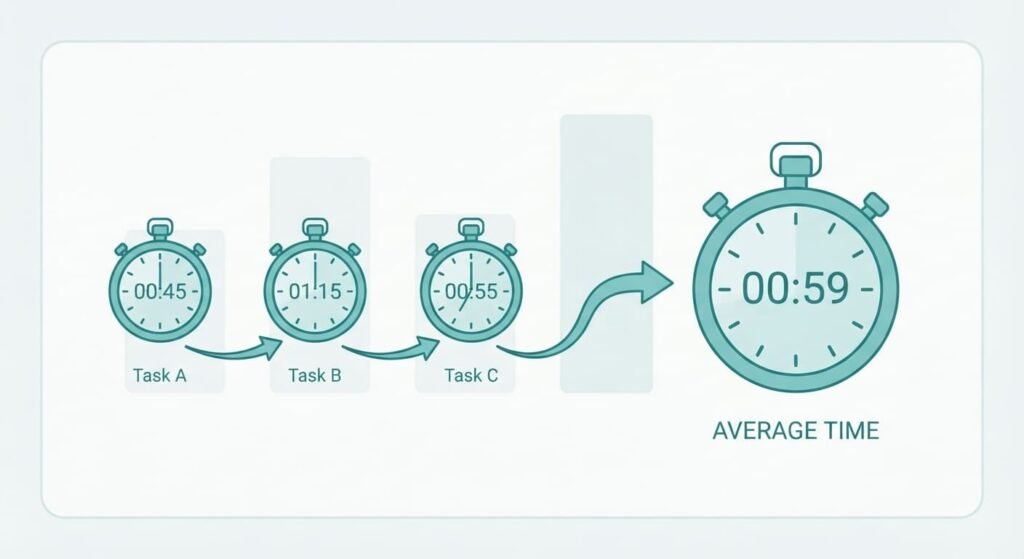
To understand how to calculate average time, convert every time into one unit (usually minutes or seconds), add them up, divide by how many there are, then convert the result back to hours and minutes. The average of 8:15, 7:50, 8:40 and 7:35 is 8 hours 5 minutes. Averaging clock times, such as bedtimes or arrival times, works the same way, with one extra step for times that cross midnight. This guide covers both, with worked examples.
Durations vs clock times
Before you start, decide which kind of time you are averaging:
- Durations are amounts of time: shift lengths, race times, call times, commute times. "How long" questions.
- Clock times are points in the day: when you woke up, when a train arrived, when you went to bed. "What time" questions.
Both are averaged the same way, but clock times need care around midnight.
How to calculate average time for durations
- Convert each duration to minutes (or seconds, if they include seconds). Hours × 60 + minutes.
- Add them all up.
- Divide by the number of durations.
- Convert back: divide by 60; the whole number is hours and the remainder is minutes.
Example: average shift length
| Shift | Hours:minutes | Minutes |
|---|---|---|
| Monday | 8:15 | 495 |
| Tuesday | 7:50 | 470 |
| Wednesday | 8:40 | 520 |
| Thursday | 7:35 | 455 |
| Total | 32:20 | 1,940 |
1,940 ÷ 4 = 485 minutes. 485 ÷ 60 = 8 remainder 5, so the average is 8 hours 5 minutes (8.08 decimal hours).
Example: average race time with seconds
Three 5K runs: 24:35, 23:50 and 25:10 (minutes:seconds).
- In seconds: 1,475 + 1,430 + 1,510 = 4,415
- 4,415 ÷ 3 = 1,471.67 seconds
- 1,471.67 ÷ 60 = 24 remainder 31.67, so the average is about 24:32
Pace works the same way. An average pace is the total time divided by the total distance, not the average of each lap's pace, unless every lap is the same length.
The decimal shortcut
You can also convert each time to decimal hours (minutes ÷ 60), average the decimals, and convert back. 8:15 is 8.25, 7:50 is 7.83, 8:40 is 8.67 and 7:35 is 7.58. Their average is 8.08 hours, which is 8 hours 5 minutes. This is handy in spreadsheets; see how to calculate time in Excel.
How to calculate average time for clock times
For times during the day, the same method works. Convert each time to minutes after midnight on the 24-hour clock, average, and convert back.
Example: average arrival time
Arrivals at 8:52 AM, 9:05 AM, 8:47 AM and 9:00 AM.
- Minutes after midnight: 532, 545, 527 and 540
- Total 2,144 ÷ 4 = 536 minutes
- 536 ÷ 60 = 8 remainder 56, so the average arrival is 8:56 AM
Times that cross midnight
Bedtimes are the classic trap. Averaging 11:30 PM and 12:30 AM the simple way gives 12:00 PM, noon, which is clearly wrong. The fix is to count times after midnight as the "next day" by adding 24 hours.
Example: bedtimes of 10:45 PM, 11:30 PM, 12:15 AM and 11:50 PM.
- On the 24-hour clock: 22:45, 23:30, 00:15 and 23:50.
- Move the after-midnight time to the next day: 00:15 becomes 24:15.
- In minutes: 1,365 + 1,410 + 1,455 + 1,430 = 5,660
- 5,660 ÷ 4 = 1,415 minutes = 23:35, so the average bedtime is 11:35 PM.
If the average comes out at 24:00 or more, subtract 24 hours. The average time calculator does this automatically by averaging on a 24-hour circle.
Weighted average time
Sometimes values count more than once. If 3 calls lasted 4 minutes and 2 calls lasted 10 minutes, the average is (3 × 4 + 2 × 10) ÷ 5 = 32 ÷ 5 = 6.4 minutes (6 minutes 24 seconds), not the average of 4 and 10.
Median time
An average can be pulled up by one very long value. If one shift was 14 hours and the rest about 8, the median (the middle value when sorted) is often a better "typical" time. Sort the times and take the middle one, or the average of the two middle ones.
How to calculate average time in Excel or Google Sheets
Spreadsheets store times as fractions of a day, so =AVERAGE(B2:B8) works on durations straight away. Format the result cell as [h]:mm for durations or h:mm AM/PM for clock times. Two cautions:
- If the durations can be longer than 24 hours, use
[h]:mmon the input cells too, or Excel will show only the leftover hours. - For bedtimes across midnight, add 1 to every time before noon in a helper column:
=IF(B2<0.5,B2+1,B2), then average that column and format it as a time. Excel drops the extra day in the display.
To average only certain rows, such as weekdays, use AVERAGEIF. The Excel time guide covers formats and formulas in more detail.
Average pace and average speed
Pace and speed are where people most often average the wrong way. The correct way to calculate average time per mile or kilometre is total time ÷ total distance.
Example: a 10K run in two halves. The first 5K took 24:00 and the second 5K took 26:00. Total time is 50:00 over 10 km, so the average pace is 5:00 per km. Here the simple average of the two halves also works, because both halves are the same length.
Now take a 3 km warm-up at 6:00 per km and a 7 km run at 5:00 per km. The simple average of the paces is 5:30, but the real total is 18 + 35 = 53 minutes over 10 km, an average pace of 5:18 per km. Unequal distances need the total method.
For speed, the same rule applies: average speed = total distance ÷ total time. Driving 60 miles at 60 mph and 60 miles at 30 mph takes 1 + 2 = 3 hours for 120 miles, an average of 40 mph, not 45.
Average time between events
To find the average time between buses, orders or support tickets, take the time from the first event to the last and divide by the number of gaps (one less than the number of events). Buses at 7:02, 7:14, 7:29 and 7:41: the span is 39 minutes across 3 gaps, so the average interval is 13 minutes. You do not need to calculate each gap separately.
Average time per task
Teams often need the average time per task to plan workloads. If a support agent handled 46 tickets in a 7.5-hour shift, the average time per ticket is 450 minutes ÷ 46 = about 9 minutes 47 seconds. In manufacturing, the same idea gives cycle time; see cycle time, takt time and lead time.
Missing days and zero values
Decide what a blank means before you average. If you did not work on Friday, leave Friday out: averaging four shifts plus a zero would pull the average down by a fifth. But if you are working out the average time spent on something per day, including days you spent no time on it, the zeros belong in the average. Both are correct answers to different questions, so state which one you used.
Worked example: a week of sleep
Here is how to calculate average time asleep and average bedtime together, from one week of records.
| Night | Bedtime | Wake | Sleep |
|---|---|---|---|
| Mon | 11:10 PM | 6:40 AM | 7:30 |
| Tue | 11:45 PM | 6:45 AM | 7:00 |
| Wed | 10:50 PM | 6:35 AM | 7:45 |
| Thu | 12:20 AM | 6:50 AM | 6:30 |
| Fri | 12:55 AM | 8:40 AM | 7:45 |
- Average sleep: 450 + 420 + 465 + 390 + 465 = 2,190 minutes ÷ 5 = 438 minutes = 7 hours 18 minutes.
- Average bedtime: with the after-midnight times moved to the next day (24:20 and 24:55), the minutes are 1,390 + 1,425 + 1,370 + 1,460 + 1,495 = 7,140 ÷ 5 = 1,428 minutes = 23:48, or 11:48 PM.
Common mistakes
- Averaging hours and minutes as if they were decimals. 7:50 is not 7.50. Convert to minutes first.
- Averaging bedtimes without handling midnight, which gives an answer around noon.
- Averaging paces or speeds instead of dividing total time by total distance.
- Rounding too early. Keep seconds or decimal minutes until the final step.
- Including blanks as zeros when the day simply was not recorded.
Summary
Whatever you are measuring, how to calculate average time comes down to the same four steps: convert to one unit, add, divide by the count, and convert back. For clock times, handle midnight first. For pace and speed, divide totals rather than averaging rates. Paste a list into the average time calculator to check your work, or use the elapsed time calculator to get each duration from start and end times.
How to calculate average time in hours, minutes and seconds
For times written as h:mm:ss, convert everything to seconds: hours × 3,600 + minutes × 60 + seconds.
Example: three podcast episodes last 1:02:15, 0:58:40 and 1:05:05.
- In seconds: 3,735 + 3,520 + 3,905 = 11,160
- 11,160 ÷ 3 = 3,720 seconds
- 3,720 ÷ 60 = 62 minutes exactly, so the average is 1:02:00
When the answer has a fraction of a second, round only at the end. 485.5 minutes is 8 hours 5 minutes 30 seconds, not 8:06.
Average time per day, week or month
To find a daily average from a total, divide by the number of days in the period. If you spent 14 hours 35 minutes on a course in one week, that is 875 minutes ÷ 7 = 125 minutes, or 2 hours 5 minutes a day. Over the five weekdays only, it would be 875 ÷ 5 = 175 minutes, or 2 hours 55 minutes a day. Both are correct, so say which days you counted.
Average response time
Support teams often track average first response time. Add the minutes between each request and its first reply, then divide by the number of requests. Five tickets answered in 12, 7, 45, 9 and 17 minutes give 90 ÷ 5 = 18 minutes.
Notice that the 45-minute ticket pulls the average up. The median here is 12 minutes, which better describes a typical customer's wait. Many teams report both, along with the 90th percentile (the time within which 9 out of 10 requests are answered).
Rolling averages
For habits such as sleep, commute or screen time, a 7-day rolling average smooths out single bad days. Each day, average the latest seven values and drop the oldest. If your last seven commutes were 32, 28, 35, 30, 41, 29 and 31 minutes, the rolling average is 226 ÷ 7 = about 32 minutes. Tomorrow, add the new commute and drop the 32.
Check your answer
A simple test catches most errors when you work out how to calculate average time by hand: the average must sit between the shortest and the longest value. If your shifts range from 7:35 to 8:40 and your average comes out at 9:12, something went wrong, usually a time that was read as a decimal. For clock times, the average should also feel right: an average bedtime of noon means midnight was not handled.
Tools that do it for you
The average time calculator accepts a list of durations or clock times, in formats like 8:15, 1h 30m or 90 min, and returns the average, total, shortest and longest values. For timing activities in the first place, use the stopwatch with laps; for finding each duration from start and end times, use the elapsed time calculator.
How to calculate average time from start and end times
If you have start and end times rather than durations, find each duration first, then average them.
| Day | Start | End | Duration | Minutes |
|---|---|---|---|---|
| Mon | 8:02 AM | 4:31 PM | 8:29 | 509 |
| Tue | 7:55 AM | 4:40 PM | 8:45 | 525 |
| Wed | 8:10 AM | 4:25 PM | 8:15 | 495 |
1,529 ÷ 3 = 509.67 minutes, which is 8 hours 29 minutes 40 seconds. You can also average the start times (8:02) and end times (4:32) separately, which tells you when a typical day begins and ends.
Average time on a basic calculator
A phone calculator does not understand hours and minutes, so type each time as a decimal: hours plus minutes ÷ 60. For 8:15, 7:50 and 8:40, type 8.25 + 7.833 + 8.667 = 24.75, then ÷ 3 = 8.25. Convert the decimal back by multiplying the part after the point by 60: 0.25 × 60 = 15, so the average is 8:15. That is how to calculate average time without a spreadsheet.
When not to use an average
An average describes the middle of a group, but it can hide what matters. If a delivery is promised within 30 minutes and the average is 25, some orders are still late. For service promises, look at the slowest 10% as well. And for very small samples, two or three values, report the values themselves; an average adds little. Knowing how to calculate average time is useful, but knowing when it tells the full story matters just as much.
Frequently asked questions
How do you calculate average time?
Convert each time to minutes or seconds, add them up, divide by the number of times, then convert the result back to hours, minutes and seconds.
How do you average times in hours and minutes?
Turn each one into minutes (hours × 60 + minutes), average the minutes, then divide by 60: the whole number is hours and the remainder is minutes.
How do you average clock times across midnight?
Add 24 hours to the times after midnight, average all the times, then subtract 24 hours if the result is 24:00 or later.
What is the average of 1:30 and 2:15?
90 + 135 = 225 minutes, divided by 2 is 112.5 minutes, which is 1 hour 52 minutes 30 seconds.
How do you calculate average time in minutes and seconds?
Convert each time to seconds (minutes × 60 + seconds), add them, divide by the count, then divide by 60: the whole number is minutes and the remainder is seconds.
What is the average of 3 times?
Add the three times in one unit and divide by 3. For 24:35, 23:50 and 25:10, the total is 4,415 seconds and the average is about 24:32.
How do you calculate average time from start and end times?
Subtract each start time from its end time to get durations, convert them to minutes, average the minutes and convert back to hours and minutes.
By the TimeNowTools team · Last reviewed 23 October 2026