How to Calculate Time and a Half: Overtime Pay Guide
Time and a half is your hourly rate × 1.5 for each overtime hour. Worked examples, charts and the rules that decide when it applies.
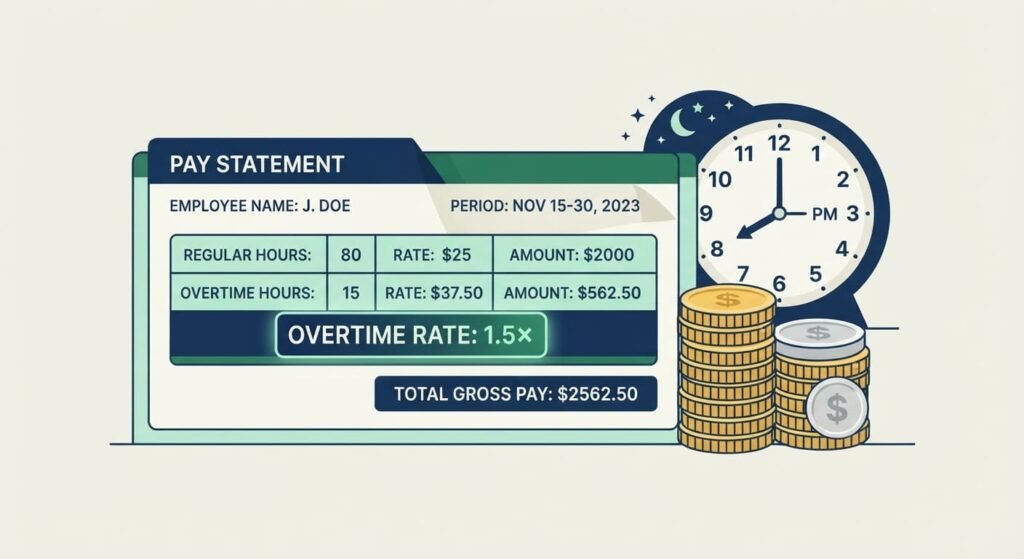
Learning how to calculate time and a half takes two steps: multiply your regular hourly rate by 1.5 to get the overtime rate, then pay that rate for every overtime hour. If you earn $20 an hour, time and a half is $30 an hour. Work 45 hours in a week and you get 40 hours at $20 plus 5 hours at $30, which is $950. This guide explains the formula, when overtime applies in the US, daily overtime in states like California, double time and the mistakes to watch for.
How to calculate time and a half, step by step
- Find your regular hourly rate. For hourly workers, it is the hourly wage. (Bonuses based on work, such as production bonuses, can raise the "regular rate" used for overtime; see below.)
- Multiply it by 1.5. $18 × 1.5 = $27. That is your time-and-a-half rate.
- Count your overtime hours. Under federal law, these are the hours over 40 in the workweek.
- Calculate regular pay and overtime pay, then add them.
Worked example
Maria earns $25 an hour and works 47 hours this week.
- Overtime rate: $25 × 1.5 = $37.50
- Regular pay: 40 × $25 = $1,000
- Overtime pay: 7 × $37.50 = $262.50
- Total: $1,262.50
A quick check: the overtime "premium" is half the regular rate for each overtime hour. 7 × $12.50 = $87.50 extra, and 47 × $25 = $1,175, plus $87.50 is $1,262.50.
Time and a half chart
| Regular rate | Time and a half | Double time | 45-hour week pay |
|---|---|---|---|
| $15.00 | $22.50 | $30.00 | $712.50 |
| $18.00 | $27.00 | $36.00 | $855.00 |
| $20.00 | $30.00 | $40.00 | $950.00 |
| $22.50 | $33.75 | $45.00 | $1,068.75 |
| $25.00 | $37.50 | $50.00 | $1,187.50 |
| $30.00 | $45.00 | $60.00 | $1,425.00 |
| $40.00 | $60.00 | $80.00 | $1,900.00 |
The last column is 40 regular hours plus 5 hours at time and a half.
Time and a half in your head
A quick way to work out time and a half: take the rate, then add half of it. $18 + $9 = $27. $22 + $11 = $33. $17.50 + $8.75 = $26.25. That is all there is to how to calculate time and a half for any hourly rate; the harder part is counting the right hours.
Weekly pay by hours worked
This chart shows weekly gross pay at $20 an hour, with time and a half for every hour over 40.
| Hours worked | Overtime hours | Weekly pay at $20 |
|---|---|---|
| 40 | 0 | $800.00 |
| 42 | 2 | $860.00 |
| 44 | 4 | $920.00 |
| 45 | 5 | $950.00 |
| 48 | 8 | $1,040.00 |
| 50 | 10 | $1,100.00 |
| 55 | 15 | $1,250.00 |
| 60 | 20 | $1,400.00 |
For a different rate, multiply the pay figure by your rate ÷ 20. At $25, a 50-hour week is $1,100 × 1.25 = $1,375.
When does overtime apply?
Federal rule: over 40 hours in a workweek
Under the US Fair Labor Standards Act (FLSA), non-exempt employees must be paid at least time and a half for hours worked over 40 in a workweek. A workweek is any fixed, recurring period of 7 consecutive days (168 hours). It does not have to start on Monday, but it cannot change week to week to avoid overtime. There is no federal requirement to pay overtime for working more than 8 hours in a day, or for weekends or holidays, unless your state or contract requires it.
Daily overtime in some states
Some states add daily overtime on top of the weekly rule. When federal and state rules differ, the rule that pays the employee more applies.
- California: time and a half after 8 hours in a day and for the first 8 hours on the seventh consecutive day of the workweek; double time after 12 hours in a day and after 8 hours on that seventh day.
- Alaska: time and a half after 8 hours in a day, for covered employers.
- Nevada: time and a half after 8 hours in a 24-hour period, for employees earning less than 1.5 times the state minimum wage.
- Colorado: time and a half after 12 hours in a workday or 12 consecutive hours.
Rules change and have exceptions, so check your state labor department for the current details.
Example with daily overtime (California)
Jordan earns $20 an hour and works 10, 10, 8, 8 and 6 hours, Monday to Friday: 42 hours in total.
- Daily overtime: 2 hours on Monday and 2 on Tuesday = 4 hours.
- Regular hours: 42 − 4 = 38, so there is no extra weekly overtime (the weekly 40 counts only regular hours that were not already paid as overtime).
- Pay: 38 × $20 + 4 × $30 = $760 + $120 = $880.
Under the federal rule alone, the same week would be 40 × $20 + 2 × $30 = $860.
What counts toward the 40 hours?
Overtime is based on hours actually worked. Paid time off, holidays and sick days usually do not count toward the 40, unless your employer's policy or contract says they do. Short paid breaks count as hours worked; unpaid meal breaks do not. For the full method, see how to calculate work hours.
The "regular rate" can be higher than the hourly wage
Under the FLSA, the overtime rate is 1.5 times the regular rate of pay, which includes most non-discretionary pay such as shift differentials and production or attendance bonuses. For example, if you earn $20 an hour, work 45 hours and get a $90 productivity bonus that week:
- Total straight-time pay: 45 × $20 + $90 = $990
- Regular rate: $990 ÷ 45 = $22
- Overtime premium: 5 hours × ($22 × 0.5) = $55
- Total: $990 + $55 = $1,045
Discretionary bonuses (truly optional gifts) and expense reimbursements are generally left out.
Overtime with two different pay rates
If you work two jobs for the same employer at different rates, the federal method uses a weighted average, sometimes called the blended rate.
Example: 30 hours at $20 as a cashier and 15 hours at $26 as a shift lead, 45 hours in total.
- Straight-time pay: 30 × $20 + 15 × $26 = $600 + $390 = $990
- Regular (blended) rate: $990 ÷ 45 = $22
- Overtime premium: 5 hours × ($22 × 0.5) = $55
- Total: $1,045
Some employers instead pay overtime at 1.5 times the rate of the job being done during the overtime hours, which is allowed if agreed in advance. Either way, the method for how to calculate time and a half stays the same: find the right rate, then add half.
Overtime on a biweekly paycheck
Overtime is counted for each workweek on its own, even when you are paid every two weeks. Two weeks of 50 and 30 hours (80 in total) still include 10 hours of overtime from the first week.
- Week 1: 40 × $20 + 10 × $30 = $1,100
- Week 2: 30 × $20 = $600
- Paycheck: $1,700, not 80 × $20 = $1,600
Double time
Double time is 2 times the regular rate. Federal law does not require it, but California does in some cases, and many union contracts and employers pay it for holidays or very long shifts. At $20 an hour, double time is $40.
Salaried employees
Salaried employees can still be owed overtime if they are non-exempt. Exempt status depends on salary level and job duties, not just being paid a salary. For a non-exempt salaried employee who is paid for a 40-hour week, the hourly rate is the weekly salary ÷ 40, and overtime hours are paid at 1.5 times that rate.
Common mistakes
- Adding minutes as decimals. 45 hours 30 minutes is 45.5 hours, so 5.5 overtime hours, not 5.3. Use the time to decimal converter.
- Averaging two weeks. Each workweek stands alone: 50 hours one week and 30 the next still means 10 overtime hours.
- Paying a flat "overtime bonus" instead of 1.5 times the regular rate.
- Ignoring state daily rules in states such as California.
Holidays and weekends
Federal law does not require extra pay for working on a weekend or a public holiday; only hours over 40 in the week count. Many employers still pay time and a half or double time for holidays by policy or union contract. If you are paid "holiday pay" at time and a half, that premium may be credited toward overtime owed in the same week, depending on how it is set up.
Step-by-step checklist
- Total your hours for the workweek (not the pay period). See how to calculate work hours.
- Find the regular rate, including non-discretionary bonuses and differentials.
- Count overtime hours: over 40 in the week, plus any state daily overtime.
- Multiply overtime hours by 1.5 times the regular rate (2 times for double time).
- Add regular pay and overtime pay, and compare with your paystub.
Follow these steps and you will know how to calculate time and a half correctly in almost any situation.
Tools
The hours calculator totals your week from start and end times, shows hours over 40 and works out pay at your rate. Apply the time and a half rate to the overtime hours it shows.
This guide explains general US rules and is not legal advice. For your situation, check with the US Department of Labor, your state labor department or an employment lawyer.
How to calculate time and a half for salaried non-exempt staff
Some employees earn a weekly salary but are still owed overtime. If the salary is meant to cover 40 hours, divide it by 40 to get the regular rate, then multiply by 1.5. A $900 weekly salary gives a regular rate of $900 ÷ 40 = $22.50 and an overtime rate of $33.75. Someone who works 46 hours earns $900 + 6 × $33.75 = $1,102.50.
Time and a half when a bonus is involved
Bonuses promised in advance, such as attendance or production bonuses, are part of the regular rate in the US. Here is how to calculate time and a half in that case:
- Straight-time pay: 45 hours × $20 = $900.
- Add the bonus: $900 + $100 = $1,000.
- Regular rate: $1,000 ÷ 45 hours = $22.22.
- Overtime premium: 0.5 × $22.22 × 5 overtime hours = $55.56.
- Total: $1,000 + $55.56 = $1,055.56.
Without the bonus in the rate, the overtime would be underpaid. Discretionary gifts, such as a surprise holiday bonus, do not count.
Tipped employees
For tipped employees in the US, overtime is based on the full minimum wage, not the lower cash wage. At the federal level, time and a half of $7.25 is $10.88 an hour. The employer can still take the same tip credit ($5.12), so the cash wage for each overtime hour is about $5.76. Many states have higher minimums and smaller or no tip credits, so check your state.
Overtime for part of an hour
Overtime is paid for every minute, not just whole hours. Convert the minutes to decimals first: 3 hours 20 minutes is 3.33 hours. At an overtime rate of $30, that is 3.33 × $30 = $100. The time to decimal converter does the conversion.
Time and a quarter, time and a half and double time
| Hourly rate | × 1.25 | × 1.5 | × 2 |
|---|---|---|---|
| $15 | $18.75 | $22.50 | $30.00 |
| $18 | $22.50 | $27.00 | $36.00 |
| $20 | $25.00 | $30.00 | $40.00 |
| $25 | $31.25 | $37.50 | $50.00 |
| $30 | $37.50 | $45.00 | $60.00 |
Time and a quarter appears in some union contracts and for certain shifts; the law in most places requires at least time and a half for overtime.
A spreadsheet formula for weekly overtime
If total hours are in B2 and the rate is in C2, this formula gives the full week's pay with time and a half after 40 hours:
=MIN(B2,40)*C2 + MAX(0,B2-40)*C2*1.5
For 47 hours at $20 it returns $800 + $210 = $1,010. More time formulas are in how to calculate time difference in Excel. Once you know how to calculate time and a half by hand, a formula like this makes checking every paycheck quick.
How to calculate time and a half for a 50-hour week
A 50-hour week is a common case, so here it is in full at $18 an hour:
- Regular pay: 40 × $18 = $720
- Overtime rate: $18 × 1.5 = $27
- Overtime pay: 10 × $27 = $270
- Total: $720 + $270 = $990
Paid at straight time, the same week would be $900, so the overtime premium is worth $90.
How to calculate time and a half on a 12-hour shift
Where only weekly overtime applies, a 12-hour day is paid at the regular rate until the week passes 40 hours. Where daily overtime applies, as in California, the hours over 8 in a day earn time and a half. At $20 an hour, a single 12-hour day in California pays 8 × $20 = $160 plus 4 × $30 = $120, a total of $280. Hours over 12 in one day would be paid at double time. Some employers with 12-hour schedules use an approved alternative workweek, which changes these thresholds.
A one-line rule to remember
If you only remember one thing about how to calculate time and a half, make it this: overtime pay = overtime hours × hourly rate × 1.5, and the hourly rate must include any non-discretionary bonuses. Add that to the regular pay for the first 40 hours and you have the week's gross pay. The hours calculator gives you the hours; the rest is one multiplication. Learning how to calculate time and a half this way also makes it easy to spot a short paycheck.
Frequently asked questions
How do you calculate time and a half?
Multiply the regular hourly rate by 1.5 to get the overtime rate, then multiply that by the overtime hours. At $20 an hour, time and a half is $30, so 5 overtime hours pay $150.
What is time and a half of $15?
$22.50 an hour: $15 × 1.5.
Is overtime after 8 hours a day or 40 hours a week?
Federal law uses 40 hours in a workweek. Some states, including California, Alaska and Nevada, also require overtime after 8 hours in a day for covered employees.
Do holidays count toward overtime?
Under federal law, paid holidays and paid time off are not hours worked, so they do not count toward the 40, unless your employer's policy says otherwise.
What is double time?
Pay at twice the regular rate. It is not required by federal law but is required in some cases in California and by many union contracts.
What is time and a half of $20?
$30 an hour: $20 × 1.5. Ten overtime hours at that rate pay $300.
How do you calculate time and a half on a salary?
For non-exempt salaried staff, divide the weekly salary by the hours it covers (often 40) to get the hourly rate, then multiply by 1.5. $900 ÷ 40 = $22.50, so time and a half is $33.75.
How do I calculate time and a half for 10 hours of overtime?
Multiply 10 by your hourly rate and by 1.5. At $18 an hour that is 10 × $18 × 1.5 = $270.
By the TimeNowTools team · Last reviewed 23 October 2026