How to Calculate Work Hours: Step-by-Step Guide With Examples
Subtract the start time from the end time, take off unpaid breaks, add up the week and convert to decimal hours.
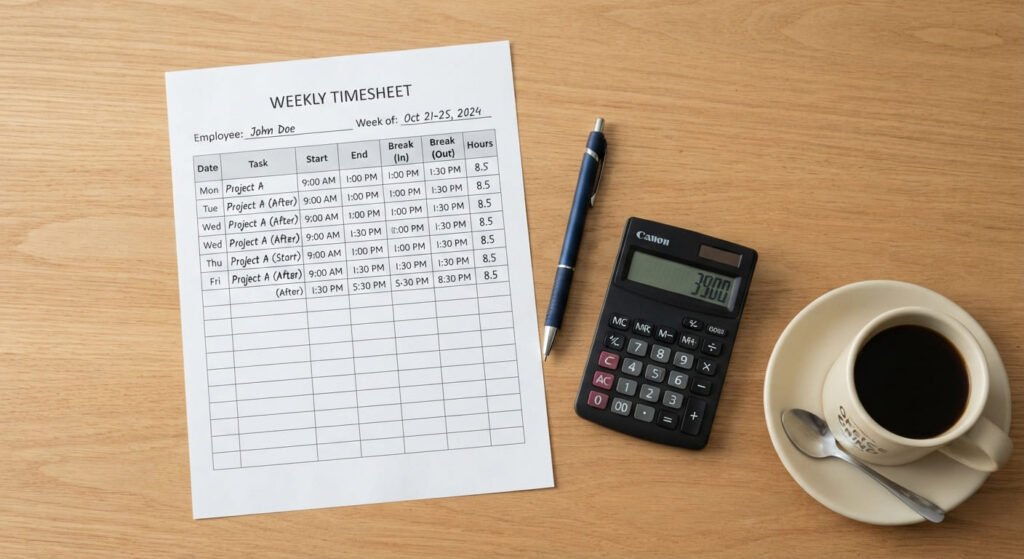
Knowing how to calculate work hours correctly protects both your paycheck and your employer's payroll. The method is simple: for each shift, subtract the start time from the end time, take off unpaid breaks, then add the days together and convert the total to decimal hours for payroll. This guide walks through each step with a full worked timesheet, overnight shifts, rounding rules and the mistakes that cost people money.
How to calculate work hours in five steps
Every method for how to calculate work hours follows the same five steps: record the times, find each day's hours, remove unpaid breaks, add up the week and convert to decimals. Each step is explained below.
Step 1: Record start, end and break times
Write down the exact time you start and finish each shift, plus the length of any unpaid break. Most timesheets use the 12-hour clock with AM and PM, but the 24-hour clock is easier to calculate with: 1:30 PM becomes 13:30 and 5:45 PM becomes 17:45. If you need help, the military time converter converts any time.
Step 2: Calculate hours for each day
Subtract the start time from the end time. If the end minutes are smaller than the start minutes, borrow one hour as 60 minutes.
Example: 8:50 AM to 5:20 PM.
- 5:20 PM is 17:20 on the 24-hour clock.
- Borrow an hour: 17:20 becomes 16 hours 80 minutes.
- 16:80 − 8:50 = 8 hours 30 minutes.
The full method, including counting up and crossing noon, is explained in how to calculate elapsed time.
Step 3: Subtract unpaid breaks
Take off any break you are not paid for, usually a meal break of 30 minutes or more. In the United States, short rest breaks of about 5 to 20 minutes count as paid working time under federal rules, so you do not subtract them. A meal break only counts as unpaid if you are fully relieved of duty. In the example above, a 30-minute unpaid lunch gives 8:30 − 0:30 = 8 hours worked.
Step 4: Add up the week
Here is a full week worked out the same way:
| Day | Start | End | Unpaid break | Hours worked |
|---|---|---|---|---|
| Monday | 8:50 AM | 5:20 PM | 30 min | 8:00 |
| Tuesday | 9:00 AM | 5:45 PM | 30 min | 8:15 |
| Wednesday | 8:30 AM | 4:00 PM | 30 min | 7:00 |
| Thursday | 9:15 AM | 6:30 PM | 45 min | 8:30 |
| Friday | 8:00 AM | 3:00 PM | 0 min | 7:00 |
| Total | 38:45 |
To add hours and minutes, add the hours and the minutes separately, then carry every 60 minutes into an hour: 8 + 8 + 7 + 8 + 7 = 38 hours, and 0 + 15 + 0 + 30 + 0 = 45 minutes, so the week is 38 hours 45 minutes.
Step 5: Convert to decimal hours for payroll
Payroll systems multiply hours by a pay rate, so they need decimal hours. Divide the minutes by 60 and add them to the hours: 45 ÷ 60 = 0.75, so 38 hours 45 minutes = 38.75 hours. At $20 an hour, that week pays 38.75 × $20 = $775.
| Minutes | Decimal | Minutes | Decimal |
|---|---|---|---|
| 6 min | 0.10 | 30 min | 0.50 |
| 12 min | 0.20 | 36 min | 0.60 |
| 15 min | 0.25 | 45 min | 0.75 |
| 20 min | 0.33 | 50 min | 0.83 |
The time to decimal converter has the full chart, both ways.
Work hours for each pay period
Once you know how to calculate work hours for a week, the pay period total is just the weeks added together. But keep each week separate when you check overtime, because overtime is counted per workweek.
| Pay schedule | Full-time hours (40/week) |
|---|---|
| Weekly | 40 |
| Biweekly (every 2 weeks) | 80 |
| Semimonthly (twice a month) | 86.67 on average |
| Monthly | 173.33 on average |
A biweekly paycheck with 85 hours might be 45 + 40 (5 hours of overtime) or 42.5 + 42.5 (2.5 + 2.5 hours of overtime). Same total, but the split by week decides the overtime.
What counts as hours worked?
In the US, the Fair Labor Standards Act counts all the time an employer requires or allows you to work. That usually includes:
- Short rest breaks of about 5 to 20 minutes.
- Required training, meetings and work done before or after the shift.
- Travel between job sites during the workday (but not the normal commute from home to work).
- On-call time when you must stay at the workplace or are so restricted you cannot use the time for yourself.
- Time spent putting on required protective gear, in many cases.
It usually does not include bona fide meal breaks of 30 minutes or more where you are fully relieved of duty, your normal commute, or on-call time you can spend at home as you like. State laws can add more, so check local rules if something is unclear.
Calculating work hours with the 24-hour clock
If your timesheet uses AM and PM, converting to the 24-hour clock first avoids most mistakes. Add 12 to the hour for any time from 1 PM to 11:59 PM:
| 12-hour | 24-hour | 12-hour | 24-hour |
|---|---|---|---|
| 1:00 PM | 13:00 | 5:00 PM | 17:00 |
| 2:00 PM | 14:00 | 6:00 PM | 18:00 |
| 3:00 PM | 15:00 | 7:00 PM | 19:00 |
| 4:00 PM | 16:00 | 11:00 PM | 23:00 |
12 PM (noon) stays 12:00, and 12 AM (midnight) becomes 00:00.
Overnight shifts
If a shift ends the next morning, the end time is smaller than the start time. Add 24 hours to the end before subtracting. A shift from 10:00 PM to 6:30 AM becomes 30:30 − 22:00 = 8 hours 30 minutes. Payroll usually counts the whole shift on the day it started, but some employers split it at midnight, so check your policy.
On the nights the clocks change for daylight saving time, a night shift really lasts one hour less (spring) or one hour more (fall) than the clock times suggest, and you should be paid for the hours actually worked.
Rounding rules
Many employers round clock-in and clock-out times. US federal rules allow rounding to the nearest 5 minutes, tenth of an hour (6 minutes) or quarter hour (15 minutes), as long as it averages out over time and does not always favor the employer. With quarter-hour rounding, the common "7-minute rule" rounds 1 to 7 minutes down and 8 to 14 minutes up. So clocking in at 8:07 counts as 8:00, and 8:08 counts as 8:15.
Overtime
Once you know how to calculate work hours, overtime is the next step. Under US federal law, non-exempt employees earn at least 1.5 times their regular rate for hours over 40 in a workweek, and some states add daily overtime. In the example week above (38.75 hours), there is no overtime. See how to calculate time and a half for worked examples.
Check your paystub
Learning how to calculate work hours pays off when you check a paycheck. Compare three numbers:
- Hours: your own weekly totals against the regular and overtime hours on the stub.
- Rates: the regular rate, and an overtime rate of at least 1.5 times it.
- Gross pay: regular hours × rate + overtime hours × overtime rate.
Example: two weeks of 38.75 and 43.5 hours at $20. Week 1 has no overtime: 38.75 × $20 = $775. Week 2 has 3.5 overtime hours: 40 × $20 + 3.5 × $30 = $905. The gross for the period should be $1,680. If the stub shows 82.25 hours all at $20 ($1,645), the $35 overtime premium is missing.
Keep your own record
Employers must keep time records, but keeping your own takes a few seconds a day: note start, end and break times on your phone or a paper card. If there is ever a dispute about pay, your notes made at the time are useful evidence. Our stopwatch can also time tasks and breaks during the day.
Salaried employees
Many salaried employees are exempt from overtime and do not need to count hours for pay. But tracking hours is still useful for workload, flexible time arrangements or billing clients. Non-exempt salaried employees do need accurate hours, because they are owed overtime above 40 hours a week. The method for how to calculate work hours is exactly the same.
Common mistakes
- Treating minutes as decimals. 7:30 is 7.5 hours, not 7.3. Always divide minutes by 60.
- Forgetting the lunch break, or subtracting paid rest breaks that should count as work time.
- Negative hours on night shifts. Add 24 hours to the end time when the shift crosses midnight.
- Mixing up 12 AM and 12 PM. 12 PM is noon and 12 AM is midnight.
- Rounding only in one direction, which is not allowed when it always shortchanges the employee.
Let a calculator do it
Knowing how to calculate work hours by hand is useful for checking a paycheck, but for weekly timesheets the hours calculator is faster: enter start, end and break for each day and it gives the weekly total, decimal hours, hours over 40 and pay. For a single shift, the time duration calculator works too.
How to calculate work hours when the minutes do not subtract
When the end minutes are smaller than the start minutes, borrow an hour. For a shift from 8:45 AM to 4:10 PM, change 4:10 PM to 16:10, then borrow: 16:10 becomes 15:70. Now subtract: 15:70 − 8:45 = 7:25, or 7 hours 25 minutes. It is the same trick you learned for subtracting numbers in school, but with 60 instead of 10.
Worked example: a full week
Here is how to calculate work hours for a real week with different start times, breaks and a half day.
| Day | Start | End | Unpaid break | Hours |
|---|---|---|---|---|
| Mon | 8:00 AM | 4:30 PM | 0:30 | 8:00 |
| Tue | 7:45 AM | 4:15 PM | 0:30 | 8:00 |
| Wed | 8:10 AM | 5:40 PM | 1:00 | 8:30 |
| Thu | 8:00 AM | 12:00 PM | 0:00 | 4:00 |
| Fri | 9:15 AM | 6:00 PM | 0:45 | 8:00 |
| Total | 36:30 |
36 hours 30 minutes is 36.5 decimal hours. At $19 an hour, the week pays 36.5 × $19 = $693.50. No overtime is due, because the total is under 40.
Split shifts
Some jobs, such as school bus driving or restaurant work, have two blocks in one day. Calculate each block separately and add them. A shift from 6:00 to 10:00 AM and another from 4:00 to 8:00 PM is 4 + 4 = 8 hours. The gap in the middle is not work time, unless you are required to stay on site and on call.
Two jobs, two calculations
If you work for two different employers, each one calculates your hours separately. 30 hours at one job and 20 at another is 50 hours of work, but neither employer owes overtime under the federal 40-hour rule, because each one only sees its own hours. The rule changes if the two employers are closely connected (joint employment), so ask HR if you are unsure.
Work hours per month and year
Once you know how to calculate work hours for a week, the longer totals follow. A 40-hour week is about 173.33 hours a month and 2,080 hours a year; a 37.5-hour week is 162.5 a month and 1,950 a year. Our guide on how to calculate FTE uses these totals to compare full-time and part-time staff.
Remote and flexible schedules
When you work from home, the day often breaks into several blocks: 8:30 to 11:45, 12:30 to 3:00 and 7:00 to 8:15 in the evening. Log each block as it happens and add them at the end: 3:15 + 2:30 + 1:15 = 7 hours. A stopwatch or a simple note on your phone makes this easy, and the record protects you if your hours are ever questioned. Knowing how to calculate work hours from blocks like these is the same skill as for a single shift, just repeated.
Travel, training and on-call time
These are the grey areas when you work out how to calculate work hours. Under US federal rules, the general guidance is:
- Normal commute: not work time. Travel between home and your usual workplace does not count.
- Travel during the workday: counts. Driving from one job site to another, or to a client meeting, is work.
- Required training and meetings: count, even outside normal hours, unless they are truly voluntary, outside working hours and unrelated to the job.
- On-call time: counts if you must stay at the workplace or are so restricted that you cannot use the time for yourself. If you can stay home and simply answer the phone, usually only the time spent working counts.
- Waiting time: waiting for the next task while on duty counts as work.
State laws can be more generous, so check the rules where you work. When in doubt, record the time separately and ask.
A quick check for any timesheet
After you calculate work hours for the week, run three checks: every day has a start and an end, breaks were subtracted only once, and the weekly total matches the sum of the daily totals. Most payroll disputes come from one of those three slips.
Frequently asked questions
How do I calculate my work hours for the week?
For each day, subtract the start time from the end time and take off unpaid breaks. Add the days together, carrying every 60 minutes into an hour, then divide the leftover minutes by 60 for decimal hours.
Is a 30-minute lunch break paid?
Usually not. Under US federal rules, a meal break of 30 minutes or more can be unpaid if you are fully relieved of duty. Short breaks of about 5 to 20 minutes count as paid work time.
How do I convert hours and minutes to decimal?
Divide the minutes by 60 and add the result to the hours. 7 hours 45 minutes is 7 + 45 ÷ 60 = 7.75 hours.
How do I calculate hours for a night shift?
Add 24 hours to the end time, then subtract the start time. 11 PM to 7 AM is 31:00 − 23:00 = 8 hours.
What is the 7-minute rule?
With quarter-hour rounding, 1 to 7 minutes past a quarter hour round down and 8 to 14 minutes round up. It is allowed in the US as long as rounding averages out over time.
How do you calculate work hours with a lunch break?
Subtract the start time from the end time, then subtract the unpaid lunch. 8:00 AM to 4:30 PM with a 30-minute lunch is 8 hours 30 minutes minus 30 minutes, which is 8 hours.
How many work hours are in a year?
2,080 hours for a 40-hour week (40 × 52), or 1,950 hours for a 37.5-hour week.
Does travel time count as hours worked?
Travel during the workday, such as between job sites, usually counts. The normal commute from home to your regular workplace does not.
By the TimeNowTools team · Last reviewed 23 October 2026