How to Calculate FTE (Full-Time Equivalent) With Examples
Divide total hours worked by full-time hours for the same period. Formulas, worked examples and the choices that change the answer.
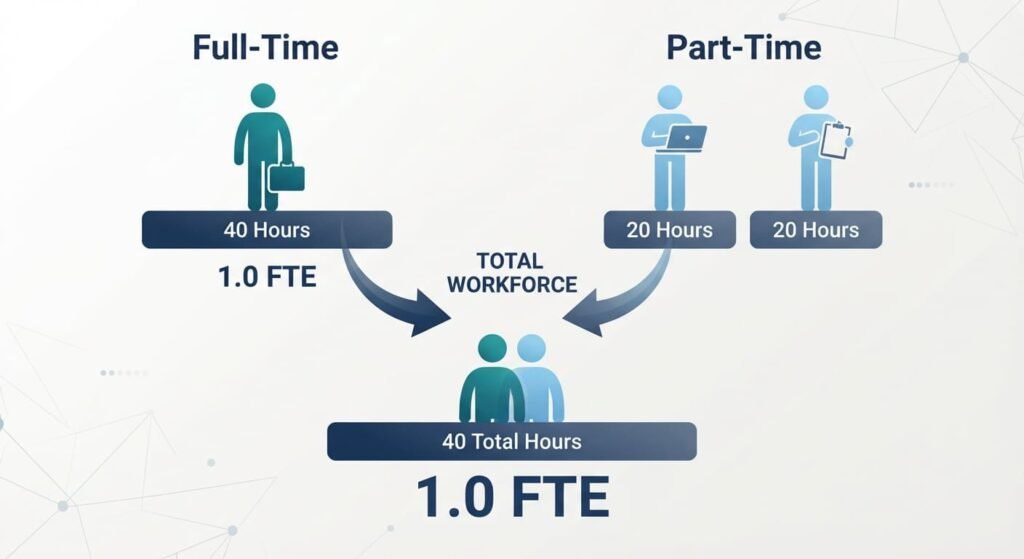
Here is how to calculate FTE (full-time equivalent): divide the total hours worked by the number of hours a full-time employee works in the same period. With a 40-hour full-time week, someone working 20 hours a week is 0.5 FTE, and a team that works 300 hours a week is 7.5 FTE. Over a year, full time is usually 2,080 hours (40 hours × 52 weeks). This guide covers the formula, working hours per week, month and year, worked examples and the choices that change the answer.
What FTE means
FTE turns a mix of full-time and part-time hours into a number of "full-time people". One FTE is one person working a full-time schedule. Two people each working half time are also 1.0 FTE together. Businesses use FTE for budgets and staffing plans, government programs use it for eligibility rules, and schools and hospitals use it to describe workloads.
How many hours is full time?
Most US employers use a 40-hour week, which gives the standard figures below. Some organizations define full time as 35, 37.5 or 30 hours, so always check the number your policy or program uses.
| Full-time week | Per month (average) | Per year (52 weeks) |
|---|---|---|
| 40 hours | 173.33 hours | 2,080 hours |
| 37.5 hours | 162.5 hours | 1,950 hours |
| 35 hours | 151.67 hours | 1,820 hours |
| 30 hours | 130 hours | 1,560 hours |
The monthly figure is the yearly figure divided by 12. So the answer to "how many hours are worked in a month?" is about 173 hours for a 40-hour week, even though a specific month can have 160 to 184 working hours depending on how many weekdays it has.
Why it matters how you calculate FTE
Two organizations with 50 people can have very different FTE counts: one may be 48 FTE, another 31. Lenders, grant funders and government programs often set rules by FTE, so knowing how to calculate FTE correctly, with the right base and the right hours, can change eligibility, reporting and budgets.
How to calculate FTE, step by step
- Choose the period: a week, a month or a year.
- Choose the full-time hours for that period: for example 40 per week or 2,080 per year.
- Add up the hours worked by everyone you are counting in that period.
- Divide total hours by full-time hours.
Example 1: one part-time employee
Sam works 24 hours a week. FTE = 24 ÷ 40 = 0.6 FTE.
Example 2: a small team, weekly
| Employee | Hours per week | FTE |
|---|---|---|
| Full-time staff (3 people) | 120 | 3.0 |
| Part-time A | 20 | 0.5 |
| Part-time B | 30 | 0.75 |
| Part-time C | 16 | 0.4 |
| Total | 186 | 4.65 |
186 ÷ 40 = 4.65 FTE, from 6 people.
Example 3: a year of hours
A business records 15,220 hours worked by all staff in a year. FTE = 15,220 ÷ 2,080 = 7.32 FTE.
Example 4: someone who joined mid-year
Alex started on 1 July and works full time, 40 hours a week for 26 weeks: 1,040 hours. For the year, that is 1,040 ÷ 2,080 = 0.5 FTE, even though Alex is a full-time employee.
Which hours to count
This is where FTE figures often differ:
- Hours worked only: leave out vacation, sick leave and holidays. Useful for measuring actual workload.
- Hours paid: include paid time off. Many government and health programs use paid hours.
- Overtime: some rules count every hour; others cap each person at 40 hours a week (1.0 FTE).
Use the definition your program, grant or policy requires, and use the same one every time so your numbers can be compared.
Monthly FTE example
To calculate FTE for a month, divide the month's hours by the full-time hours for that month. Using the average of 173.33 hours (40-hour basis):
- Total hours recorded in March: 1,560
- FTE = 1,560 ÷ 173.33 = 9.0 FTE
If you prefer the exact working hours of the month, count its weekdays: a month with 22 weekdays has 176 working hours, so 1,560 ÷ 176 = 8.86 FTE. Both are valid; just use the same method every month.
How to calculate FTE under the Affordable Care Act (US)
The ACA uses its own definitions, which differ from the 40-hour method:
- A full-time employee averages at least 30 hours a week, or 130 hours a month.
- Full-time equivalent employees are counted by adding the monthly hours of all part-time employees (counting at most 120 hours for each person) and dividing by 120.
- An employer with 50 or more full-time employees plus full-time equivalents is an "applicable large employer" with health coverage obligations.
Example: 40 full-time employees, plus 20 part-time employees who each work 60 hours a month. Part-time FTE = (20 × 60) ÷ 120 = 10. Total = 40 + 10 = 50, so the employer reaches the threshold. The rules include averaging over the year and several exceptions, so check IRS guidance or a benefits adviser for compliance.
Cost per FTE
FTE is useful for budgets because it puts full-time and part-time costs on the same footing. Divide the total staffing cost by the FTE count. If a department spends $520,000 a year on pay and benefits for 7.32 FTE, the cost per FTE is $520,000 ÷ 7.32 = about $71,038. You can then estimate the cost of adding 0.5 FTE as about $35,500.
FTE vs headcount
Headcount is the number of people; FTE is the amount of full-time work they provide. In example 2, the headcount is 6 but the FTE is 4.65. FTE is better for planning workload and cost; headcount is better for things like desks, equipment and benefits enrollment.
Converting FTE back to hours
Multiply the FTE by the full-time hours. A 0.8 FTE role is 0.8 × 40 = 32 hours a week, or 0.8 × 2,080 = 1,664 hours a year. A job advertised as 0.6 FTE is 24 hours a week.
| FTE | Hours per week (40-hour basis) | Hours per year |
|---|---|---|
| 1.0 | 40 | 2,080 |
| 0.9 | 36 | 1,872 |
| 0.8 | 32 | 1,664 |
| 0.75 | 30 | 1,560 |
| 0.6 | 24 | 1,248 |
| 0.5 | 20 | 1,040 |
| 0.25 | 10 | 520 |
Daily hours from a weekly figure
To find daily hours, divide the weekly hours by the number of working days. 35 hours a week over 5 days is 7 hours a day; 37.5 hours is 7.5 hours a day. For turning those hours into clock shifts, see the work shift hours chart.
FTE in schools, hospitals and universities
Many sectors describe jobs in FTE rather than hours. A 0.8 FTE nurse works 80% of a full-time schedule; on a 36-hour full-time basis (three 12-hour shifts) that is about 29 hours a week. A 0.5 FTE lecturer teaches half of a full workload. In each case, the method for how to calculate FTE is the same, but the full-time base changes, so always state which base you used.
Common mistakes
- Mixing bases: using 40 hours for some people and 37.5 for others in the same total.
- Counting overtime as extra FTE when the purpose is staffing, so one busy person shows as 1.3 people.
- Using headcount where a rule or grant asks for FTE.
- Forgetting partial years for new hires and leavers.
- Adding hours and minutes as decimals: 37 hours 30 minutes is 37.5 hours, not 37.3.
Getting accurate hours
FTE is only as good as the hours behind it. Collect actual start and end times, take off unpaid breaks, and convert minutes to decimal hours before you add them up. Our guide on how to calculate work hours explains each step, and the hours calculator totals a week for you.
Worked example: a restaurant week
Here is how to calculate FTE for a business with a mix of long and short schedules, and what changes if you cap each person at 1.0.
| Employee | Hours this week | FTE (÷ 40) |
|---|---|---|
| Head chef | 45 | 1.125 |
| Manager | 40 | 1.0 |
| Cook | 38 | 0.95 |
| Server A | 32 | 0.8 |
| Server B | 28 | 0.7 |
| Server C | 25 | 0.625 |
| Host | 20 | 0.5 |
| Dishwasher A | 16 | 0.4 |
| Dishwasher B | 12 | 0.3 |
| Weekend busser | 8 | 0.2 |
| Total | 264 | 6.6 |
264 ÷ 40 = 6.6 FTE from a headcount of 10. If your program caps each person at 40 hours, the head chef counts as 40, the total becomes 259 hours and the FTE is 6.475. That small difference matters when a rule has a hard threshold.
How to calculate FTE in Excel or Google Sheets
Put each person's hours in column B. Then:
- FTE for each person:
=B2/40 - FTE capped at 1.0:
=MIN(B2,40)/40 - Team FTE for the week:
=SUM(B2:B11)/40 - Yearly FTE from annual hours:
=SUM(B2:B11)/2080
Keep the full-time hours in a single cell, such as F1, and use =B2/$F$1. Then you can switch between a 40-hour and a 37.5-hour base without editing every formula. If your hours are stored as times (8:30) rather than decimals (8.5), multiply by 24 first; see how to calculate time difference in Excel.
FTE in grant budgets
Grant applications often ask for staff time as FTE. To budget a role, multiply the FTE by the full annual salary. A program manager on a $60,000 salary working 0.25 FTE on the project costs $15,000 a year, plus the matching share of benefits. When you report later, show the hours actually spent on the project: 520 hours ÷ 2,080 = 0.25 FTE.
Planning coverage with FTE
FTE also works in reverse, to find how many people a schedule needs. A front desk open 16 hours a day, 7 days a week, needs 112 hours of cover each week. 112 ÷ 40 = 2.8 FTE. People take vacation, get sick and attend training, so add an allowance: if staff are available about 85% of the time, you need 2.8 ÷ 0.85 = about 3.3 FTE. That might be three full-time staff plus one person on 12 hours a week.
Contractors, temps and volunteers
Whether these count depends on the reason you are counting. Staff supplied by an agency are usually employees of the agency, not of you. Independent contractors are not employees. Volunteers are normally left out. When a lender, funder or government agency gives you instructions on how to calculate FTE, follow their definition exactly, even if it differs from the one you use for internal planning.
Summary
To recap how to calculate FTE: pick a period, pick the full-time hours for that period, add up the hours, and divide. Write down the base you used (40, 37.5, 30 or 2,080 a year), apply it the same way every time, and check whether your purpose counts hours worked or hours paid.
How to calculate FTE for a year with joiners and leavers
Annual FTE handles people who were only on the payroll for part of the year. Add up each person's hours for the year and divide the total by 2,080.
| Employee | Situation | Annual hours |
|---|---|---|
| Ana | Full time all year | 2,080 |
| Ben | Full time all year | 2,080 |
| Chloe | Joined 1 July, full time | 1,040 |
| Dev | 30 hours a week all year | 1,560 |
| Eve | Left at the end of March, full time | 520 |
| Total | 7,280 |
7,280 ÷ 2,080 = 3.5 FTE, from five people who appeared on the payroll during the year.
Hours worked vs hours paid: a worked example
A full-time employee is paid for 2,080 hours, including 120 hours of PTO and 80 hours of paid holidays. Counting hours paid, they are 2,080 ÷ 2,080 = 1.0 FTE. Counting hours actually worked, they are 1,880 ÷ 2,080 = 0.90 FTE. Neither answer is wrong. Knowing how to calculate FTE both ways helps you explain why a team of ten full-time people delivers roughly nine people's worth of work across a year.
FTE ratios
Many sectors compare workload per FTE rather than per person: students per teaching FTE, patients per nursing FTE, revenue per FTE. A business with $1.2 million in revenue and 7.5 FTE earns $160,000 per FTE. Using FTE rather than headcount makes these ratios fair between teams with different part-time mixes.
Quick reference: how to calculate FTE for any period
| Period | Formula (40-hour basis) | Example |
|---|---|---|
| Day | Hours ÷ 8 | 52 team hours ÷ 8 = 6.5 FTE |
| Week | Hours ÷ 40 | 186 hours ÷ 40 = 4.65 FTE |
| Two weeks | Hours ÷ 80 | 560 hours ÷ 80 = 7 FTE |
| Month | Hours ÷ 173.33 | 1,560 hours ÷ 173.33 = 9 FTE |
| Quarter | Hours ÷ 520 | 2,860 hours ÷ 520 = 5.5 FTE |
| Year | Hours ÷ 2,080 | 15,220 hours ÷ 2,080 = 7.32 FTE |
For a 37.5-hour basis, replace the divisors with 7.5, 37.5, 75, 162.5, 487.5 and 1,950. The method for how to calculate FTE does not change, only the full-time hours you divide by. If your hours are recorded in hours and minutes, convert them to decimals first with the time to decimal converter, then total them with the hours calculator.
One last tip: round FTE to two decimal places for reports, but keep the full figure in your working. Rounding each person to 0.1 FTE before adding can move a team total by several tenths, which matters when a rule draws its line at a whole number.
Frequently asked questions
How do you calculate FTE?
Divide the total hours worked by the full-time hours for the same period. With a 40-hour week, 20 hours is 0.5 FTE and 300 team hours is 7.5 FTE.
How many hours is 1 FTE per year?
Usually 2,080 hours, based on 40 hours a week for 52 weeks. With a 37.5-hour week it is 1,950 hours.
How many hours are worked in a month?
About 173.33 hours on average for a 40-hour week (2,080 ÷ 12). A particular month can have 160 to 184 working hours depending on its weekdays.
How many hours a week is 0.8 FTE?
32 hours a week on a 40-hour basis (0.8 × 40).
Is FTE the same as headcount?
No. Headcount counts people; FTE counts full-time workloads. Two half-time employees are a headcount of 2 and 1.0 FTE.
How do you calculate FTE for part-time employees?
Divide each part-timer's hours by full-time hours. On a 40-hour basis, 24 hours a week is 0.6 FTE and 16 hours is 0.4 FTE. Add them together for the part-time total.
How do you calculate FTE in Excel?
With hours in column B, use =B2/40 for each person and =SUM(B2:B20)/40 for the team. For a year of hours, divide by 2,080 instead.
How do you calculate FTE for a year?
Add up the hours everyone worked (or was paid for) during the year and divide by 2,080, the hours in a 40-hour full-time year. 7,280 hours is 3.5 FTE.
By the TimeNowTools team · Last reviewed 23 October 2026