How Many Hours Is 9 to 5? Work Shift Hours Chart
9 to 5 is 8 hours on the clock. See how many hours any shift is, with and without breaks, plus weekly and yearly totals.
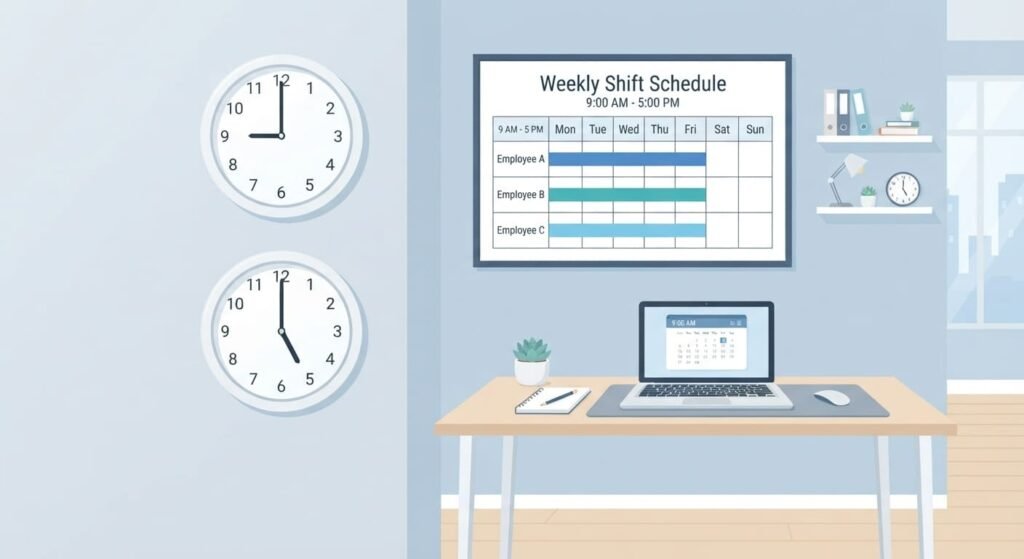
How many hours is 9 to 5? A 9 to 5 shift is 8 hours on the clock. If you take an unpaid 30-minute lunch, you work and get paid for 7.5 hours; with an unpaid one-hour lunch, it is 7 hours. Over a five-day week that adds up to 40 clock hours, or 37.5 paid hours with a half-hour lunch.
This guide answers the 9 to 5 question first, then gives a chart of the most common day, evening and night shifts, with and without lunch, so you can look up any shift in seconds.
How many hours is 9 to 5, step by step
Count from the start to the end of the shift. From 9 AM to 12 PM is 3 hours, and from 12 PM to 5 PM is 5 hours, so 9 to 5 is 3 + 5 = 8 hours. You can also convert 5 PM to the 24-hour clock (17:00) and subtract: 17 − 9 = 8.
Whether you get paid for all 8 hours depends on your break:
- Paid lunch or no lunch: 8 paid hours a day, 40 a week.
- Unpaid 30-minute lunch: 7.5 paid hours a day, 37.5 a week.
- Unpaid 1-hour lunch: 7 paid hours a day, 35 a week.
In the United States, federal rules treat short rest breaks of about 5 to 20 minutes as paid work time, while a genuine meal break of 30 minutes or more, where you are fully relieved of duty, can be unpaid. Some states, such as California, also require meal breaks after a set number of hours. Your contract or employee handbook tells you which applies to you.
Work shift hours chart
The chart shows the length of common shifts on the clock, and the paid hours after a 30-minute or 1-hour unpaid break. Decimal hours, used on most timesheets, are in brackets.
| Shift | Clock hours | With 30-min lunch | With 1-hour lunch |
|---|---|---|---|
| 9 AM to 5 PM | 8 h | 7 h 30 min (7.5) | 7 h (7) |
| 9 AM to 5:30 PM | 8 h 30 min | 8 h (8) | 7 h 30 min (7.5) |
| 8 AM to 5 PM | 9 h | 8 h 30 min (8.5) | 8 h (8) |
| 8 AM to 4 PM | 8 h | 7 h 30 min (7.5) | 7 h (7) |
| 8 AM to 3 PM | 7 h | 6 h 30 min (6.5) | 6 h (6) |
| 8 AM to 4:30 PM | 8 h 30 min | 8 h (8) | 7 h 30 min (7.5) |
| 8:30 AM to 5 PM | 8 h 30 min | 8 h (8) | 7 h 30 min (7.5) |
| 8:30 AM to 5:30 PM | 9 h | 8 h 30 min (8.5) | 8 h (8) |
| 7 AM to 3 PM | 8 h | 7 h 30 min (7.5) | 7 h (7) |
| 7 AM to 4 PM | 9 h | 8 h 30 min (8.5) | 8 h (8) |
| 7 AM to 3:30 PM | 8 h 30 min | 8 h (8) | 7 h 30 min (7.5) |
| 7:30 AM to 4 PM | 8 h 30 min | 8 h (8) | 7 h 30 min (7.5) |
| 7 AM to 7 PM | 12 h | 11 h 30 min (11.5) | 11 h (11) |
| 6 AM to 2 PM | 8 h | 7 h 30 min (7.5) | 7 h (7) |
| 6 AM to 6 PM | 12 h | 11 h 30 min (11.5) | 11 h (11) |
| 10 AM to 6 PM | 8 h | 7 h 30 min (7.5) | 7 h (7) |
| 10 AM to 7 PM | 9 h | 8 h 30 min (8.5) | 8 h (8) |
| 11 AM to 7 PM | 8 h | 7 h 30 min (7.5) | 7 h (7) |
| 12 PM to 8 PM | 8 h | 7 h 30 min (7.5) | 7 h (7) |
| 2 PM to 10 PM | 8 h | 7 h 30 min (7.5) | 7 h (7) |
| 3 PM to 11 PM | 8 h | 7 h 30 min (7.5) | 7 h (7) |
| 4 PM to 12 AM | 8 h | 7 h 30 min (7.5) | 7 h (7) |
| 7 PM to 7 AM | 12 h | 11 h 30 min (11.5) | 11 h (11) |
| 10 PM to 6 AM | 8 h | 7 h 30 min (7.5) | 7 h (7) |
| 11 PM to 7 AM | 8 h | 7 h 30 min (7.5) | 7 h (7) |
Night shifts that cross midnight, such as 10 PM to 6 AM, are counted into the next morning. For any other start and end time, use the time duration calculator.
How to work out any shift yourself
Once you know how many hours is 9 to 5, every other shift works the same way.
- Write both times on the 24-hour clock. Add 12 to any PM hour from 1 PM onward: 4:30 PM becomes 16:30.
- Subtract the start from the end. If the end minutes are smaller, borrow an hour (60 minutes). 16:30 − 8:45 becomes 15:90 − 8:45 = 7:45.
- If the end is earlier than the start, the shift crosses midnight. Add 24 hours to the end: 10 PM to 6 AM is 30:00 − 22:00 = 8 hours.
- Take off unpaid breaks. 7:45 minus a 30-minute lunch is 7:15.
- Convert to decimal if your timesheet needs it. Divide the minutes by 60: 7 hours 15 minutes is 7.25 hours.
Our guide on how to calculate elapsed time covers these steps in more depth, with practice problems.
Common shift patterns
Standard office day: 9 to 5 or 8 to 5
The classic office day is 9 to 5, 8 hours on the clock. Many workplaces now use 8 to 5 or 9 to 6 with a one-hour unpaid lunch, which still gives 8 paid hours. That is why "how many hours is 8 to 5" (9 clock hours) and "how many hours is 9 to 5" both lead to an 8-hour paid day once lunch is taken out.
Early shifts: 6 to 2 and 7 to 3
Healthcare, retail and warehouse teams often start at 6 or 7 AM. A 7 to 3 shift is 8 clock hours, the same as 9 to 5, just two hours earlier.
Swing and evening shifts: 3 to 11
The second shift in a three-shift operation usually runs 3 PM to 11 PM, 8 hours.
Night shifts: 11 to 7 and 10 to 6
Night shifts cross midnight. 11 PM to 7 AM is 8 hours, and 7 PM to 7 AM is 12 hours. On the nights the clocks change for daylight saving time, a night shift really lasts 7 or 9 hours, even though the clock times look the same.
12-hour shifts
Hospitals, emergency services and factories often run two 12-hour shifts a day, such as 7 AM to 7 PM and 7 PM to 7 AM. Three 12-hour shifts make a 36-hour week; four make 48 hours, which usually includes overtime in the US. See how to calculate time and a half for how that is paid.
How many hours is a 9 to 5 week, month and year?
| Period | No unpaid break | 30-min unpaid lunch |
|---|---|---|
| Day | 8 hours | 7.5 hours |
| Week (5 days) | 40 hours | 37.5 hours |
| Month (average) | 173.3 hours | 162.5 hours |
| Year (52 weeks) | 2,080 hours | 1,950 hours |
The monthly figure is the yearly figure divided by 12. For how these numbers feed into staffing and part-time percentages, read how to calculate FTE.
Part-time shift lengths
Part-time shifts are usually 4 to 6 hours, and short shifts often have no unpaid break at all. These are the most common:
| Shift | Hours | 5 days a week |
|---|---|---|
| 9 AM to 1 PM | 4 h | 20 h |
| 9 AM to 2 PM | 5 h | 25 h |
| 9 AM to 3 PM | 6 h | 30 h |
| 10 AM to 2 PM | 4 h | 20 h |
| 12 PM to 5 PM | 5 h | 25 h |
| 4 PM to 10 PM | 6 h | 30 h |
| 5 PM to 9 PM | 4 h | 20 h |
A 9 AM to 3 PM school-hours shift is 6 hours, two hours short of the 8 hours in a 9 to 5. Five of them make a 30-hour week, which many employers, and the Affordable Care Act in the US, treat as full time for benefits.
Compressed and alternative schedules
Not every full-time job is five 8-hour days. These schedules give the same 40 hours, or close to it, in fewer days:
- 4/10: four 10-hour days, such as 7 AM to 5:30 PM with a 30-minute lunch. 40 hours, with a three-day weekend every week.
- 9/80: over two weeks, eight 9-hour days, one 8-hour day and one day off. 80 hours in two weeks, with every other Friday off.
- 3/12: three 12-hour shifts, common in nursing. 36 hours a week; often treated as full time.
- Split shift: two parts in one day, such as 6 AM to 10 AM and 4 PM to 8 PM. Count both parts: 4 + 4 = 8 hours.
Overtime under US federal law is based on hours per workweek, not per day, so a 4/10 schedule does not usually trigger overtime. Some states, such as California, have daily overtime rules with special exceptions for approved alternative workweek schedules.
From shift hours to weekly pay
To turn a shift into pay, use paid hours, not clock hours. Suppose you work 8 AM to 4:30 PM, five days a week, with a 30-minute unpaid lunch, at $19 an hour.
- Clock hours: 8 AM to 4:30 PM = 8.5 hours.
- Paid hours: 8.5 − 0.5 = 8 hours a day, 40 a week.
- Weekly pay: 40 × $19 = $760.
- Yearly pay (52 weeks): $39,520.
If your week goes over 40 hours, the extra hours are usually paid at time and a half. See how to calculate time and a half.
Shift lengths by industry
- Offices: 9 to 5, 8:30 to 5 or 8 to 5, usually with an unpaid lunch. So how many hours is 9 to 5 in an office? Typically 7.5 or 8 paid hours.
- Healthcare: 8-hour shifts (7 to 3, 3 to 11, 11 to 7) or 12-hour shifts (7 to 7).
- Retail and restaurants: varied shifts of 4 to 9 hours, often changing week to week.
- Warehouses and factories: three 8-hour shifts or two 10 to 12-hour shifts to cover the day.
- Emergency services: 12-hour shifts or 24 hours on, 48 hours off for many fire departments.
Adding up a whole week of shifts
Knowing how many hours is 9 to 5 is enough when every day is the same. If your hours change from day to day, add each day's paid time, then convert the total. A week of 7:45, 8:00, 7:30, 8:15 and 6:50 adds up to 38 hours 20 minutes, or 38.33 decimal hours. The hours calculator does this for a full week, including breaks, overnight shifts and an optional hourly rate.
Common mistakes when counting shift hours
- Counting the hours on your fingers. From 9 to 5 you say "9, 10, 11, 12, 1, 2, 3, 4, 5", which is nine numbers but only 8 hours. Count the gaps, not the numbers.
- Forgetting the lunch break, so you think you work 40 paid hours when it is really 37.5.
- Mixing up AM and PM on shifts that cross noon or midnight.
- Writing 7:30 as 7.3 on a timesheet. 7 hours 30 minutes is 7.5 decimal hours.
So the next time someone asks how many hours is 9 to 5, the full answer is: 8 hours on the clock, and usually 7 to 8 paid hours depending on lunch.
How many hours is 9 to 5 with a lunch break?
The clock says 8 hours, but the hours you are paid for depend on the lunch policy. This is the part people most often get wrong when they ask how many hours is 9 to 5.
| 9 to 5 with | Hours per day | Hours per week | Hours per year |
|---|---|---|---|
| Paid lunch or no lunch | 8 | 40 | 2,080 |
| 30-minute unpaid lunch | 7.5 | 37.5 | 1,950 |
| 1-hour unpaid lunch | 7 | 35 | 1,820 |
Short rest breaks of 5 to 20 minutes are usually paid in the US, so they stay in the total. Meal breaks of 30 minutes or more, when you are fully relieved of duty, are usually unpaid.
9 to 5 in other countries
The "9 to 5" idea travels, but the exact hours differ. In the UK many offices run 9 to 5:30 with a one-hour lunch, which is 7.5 hours of work and a 37.5-hour week. France has a 35-hour legal working week. In Japan, 9 to 6 with an hour break is common, giving an 8-hour day. So how many hours is 9 to 5 in practice? Somewhere between 7 and 8 paid hours, depending on the country and the employer.
Flexible hours and core time
Many employers now set core hours, such as 10 AM to 3 PM, and let staff choose when to start and finish around them. The total stays the same: someone who works 7:30 to 3:30 with a 30-minute unpaid lunch does 7.5 hours, exactly like a 9 to 5:30 colleague with an hour off. Count the hours, not the start time.
Turning shift hours into decimals
Payroll systems use decimal hours. Divide the minutes by 60: 7 hours 30 minutes is 7.5, 8 hours 45 minutes is 8.75 and 7 hours 20 minutes is 7.33. Our time to decimal converter has the full table, and the hours calculator adds up a week of shifts with breaks.
Frequently asked questions
How many hours is 9 to 5?
8 hours on the clock. With an unpaid 30-minute lunch you are paid for 7.5 hours, and with an unpaid 1-hour lunch, 7 hours.
Is 9 to 5 a 40-hour week?
On the clock, yes: 8 hours a day for 5 days. If your lunch is unpaid, your paid week is 37.5 hours with a 30-minute lunch or 35 hours with a 1-hour lunch.
How many hours is 8 to 5?
9 hours on the clock. With a 1-hour unpaid lunch, that is an 8-hour paid day.
How many hours is 7 to 3?
8 hours. With a 30-minute unpaid lunch it is 7.5 paid hours.
How do I count a night shift that crosses midnight?
Add 24 hours to the end time before you subtract. 10 PM to 6 AM is 30:00 minus 22:00, which is 8 hours.
How many hours is 9 to 5 with a 1-hour lunch?
7 hours of paid work, or 35 hours a week, if the lunch hour is unpaid. With a paid lunch it is 8 hours.
How many hours is 9 to 5 in a year?
2,080 hours with no unpaid break (8 hours × 5 days × 52 weeks), or 1,950 hours with a 30-minute unpaid lunch.
By the TimeNowTools team · Last reviewed 23 October 2026