How Many Hours Between Shifts? Rest and Break Rules Explained
Minimum rest between shifts and meal and rest breaks in the US, UK, EU, Canada and Australia, with examples.
How many hours between shifts does the law require? In most of the US, none: federal law sets no minimum rest between shifts for adult workers. A few cities and states, mostly for retail and food service, require 9 to 11 hours, and the UK and EU require 11 hours of rest in every 24. This guide covers how many hours between shifts you are entitled to in the main places, the rules for meal and rest breaks, and what nurses on 12-hour shifts can usually expect.
This guide summarises common rules for general information. Laws change and many details depend on your job, age and contract. It is not legal advice; check with your state labor department, employer or union.
How many hours between shifts: quick reference
| Where | Minimum rest between shifts | Notes |
|---|---|---|
| US federal law | No general minimum | Separate rules for truck drivers and some transport jobs |
| Oregon (large retail, hospitality, food service) | 10 hours | Hours worked inside the rest period paid at time and a half |
| Seattle (large retail and food service) | 10 hours | Time and a half for hours inside the rest period |
| Chicago (covered industries) | 10 hours | Time and a quarter for hours inside the rest period |
| New York City (fast food) | 11 hours between a closing and next-day opening shift | Allowed with written consent plus a premium |
| United Kingdom | 11 hours in every 24 | 12 hours for workers under 18 |
| European Union | 11 consecutive hours in every 24 | Set by the Working Time Directive |
| Canada (federally regulated workplaces) | 8 hours | Provinces set their own rules for other workers |
How many hours between shifts in the US
The Fair Labor Standards Act regulates minimum wage and overtime, but it doesn't set any minimum rest between shifts for adults. An employer can legally schedule you to close at 11 PM and open at 6 AM, unless a state or city law, a union contract or an industry rule says otherwise. Overtime still applies: every hour counts toward the 40-hour week.
Fair workweek and predictive scheduling laws
Several cities and one state have "fair workweek" laws that tackle back-to-back closing and opening shifts, known as clopening. They usually apply to large employers in retail, hospitality and food service:
- Oregon: 10 hours between shifts; hours worked inside that period are paid at time and a half.
- Seattle: 10 hours; hours inside the rest period are paid at time and a half.
- Chicago: 10 hours; hours inside the rest period are paid at time and a quarter.
- New York City: fast food workers must have 11 hours between a closing shift and the next day's opening shift, unless they agree in writing and are paid a premium.
Other cities have similar rules, and coverage thresholds change, so check your local labor office for the current details.
Industry rules
Some jobs have rest rules for safety reasons. Commercial truck drivers carrying property, for example, must have 10 consecutive hours off duty before driving again under federal hours-of-service rules. Pilots, rail and maritime workers have their own limits. Many states also limit mandatory overtime for nurses.
Rest between shifts in the UK, EU and Canada
- UK: adult workers are entitled to 11 consecutive hours of rest in each 24-hour period, a 20-minute break when the working day is longer than 6 hours, and 24 hours off each week (or 48 hours each fortnight). Workers under 18 get 12 hours of daily rest and a 30-minute break after 4.5 hours.
- EU: the Working Time Directive sets 11 consecutive hours of daily rest, a break when the day exceeds 6 hours, and a weekly rest of 24 hours plus the daily 11.
- Canada: federally regulated employees are entitled to at least 8 hours of rest between shifts and a 30-minute break during every 5 consecutive hours of work. Provinces set rules for everyone else.
Some exceptions apply, for example for shift changeovers, emergencies and certain jobs, usually with compensatory rest.
Meal and rest breaks during a shift (US)
Federal law doesn't require meal or rest breaks for adults. If an employer offers short breaks of 5 to 20 minutes, they must be paid. Meal periods of 30 minutes or more can be unpaid if you are fully relieved of duty. Many states go further:
- California: a 30-minute meal period before the end of the fifth hour, a second one for shifts over 10 hours, and a paid 10-minute rest break for every 4 hours worked or major fraction of 4 hours.
- New York: a meal period for shifts over 6 hours, for example 30 minutes around midday, and 45 minutes for shifts over 6 hours that start between 1 PM and 6 AM.
- Other states: about half the states have some meal break rule, and a smaller number require rest breaks. Rules for workers under 18 are usually stricter.
Breaks affect how many hours you are paid. An 8.5-hour shift with an unpaid 30-minute meal is 8 paid hours; our guide on how to calculate work hours shows how to subtract breaks.
Breaks for nurses on 12-hour shifts
There is no single national rule. Most hospitals schedule a 30-minute meal break plus one or two 15-minute rest breaks on a 12-hour shift, under hospital policy, union contracts and state law. In California, healthcare employees working shifts over 8 hours may be allowed to waive the second meal period. In practice, nurses often struggle to take breaks on busy units, so many hospitals use break-relief nurses. If breaks are routinely missed, ask how missed breaks are recorded and paid.
How to work out the hours between shifts
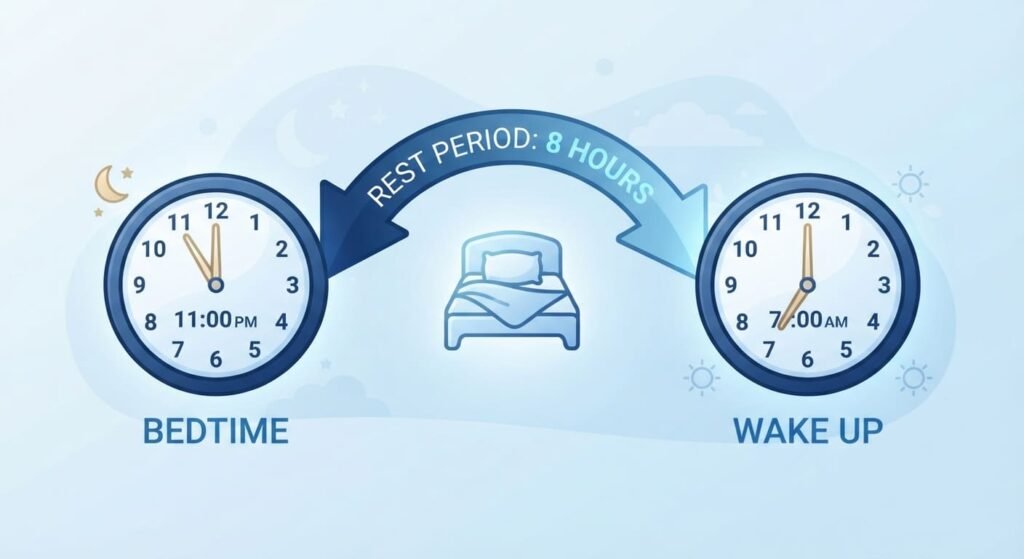
Count from the end of one shift to the start of the next. If you finish at 11 PM and start again at 7 AM, that is 1 hour to midnight plus 7 hours, 8 hours in total. From 10:30 PM to 6 AM is 7.5 hours. The elapsed time calculator works it out across midnight and across days, and the time clock keeps a record of when each shift really ended.
| Shift ends | Next shift starts | Rest |
|---|---|---|
| 11:00 PM | 7:00 AM | 8 h |
| 10:30 PM | 6:00 AM | 7.5 h |
| 7:00 PM | 7:00 AM | 12 h |
| 7:00 AM (night shift) | 7:00 PM | 12 h |
| 12:00 AM | 8:00 AM | 8 h |
Why rest between shifts matters
Short turnarounds cut into sleep: with 8 hours between shifts, the commute, meals and getting ready often leave five or six hours for sleep. Over a run of shifts that builds into fatigue, which affects concentration, mood and safety, especially in driving, healthcare and machinery work. That is why many laws focus on 10 to 11 hours, which leaves room for a full night's sleep.
Tips if you work back-to-back shifts
- Ask whether a local fair workweek law or your contract gives you a minimum rest period or a premium.
- Keep a record of shift end and start times, so any premium can be checked.
- Prioritise sleep on short turnarounds: prepare food and clothes before the late shift.
- If you rotate between days and nights, see our guide to 12-hour shift schedules for patterns with longer breaks.
How many hours between shifts under a 10-hour rule
Where a 10-hour rest rule applies, these are the earliest start times after common closing times:
| Shift ends | Earliest start with 10 hours rest | With 11 hours rest |
|---|---|---|
| 9:00 PM | 7:00 AM | 8:00 AM |
| 10:00 PM | 8:00 AM | 9:00 AM |
| 11:00 PM | 9:00 AM | 10:00 AM |
| 12:00 AM | 10:00 AM | 11:00 AM |
| 1:00 AM | 11:00 AM | 12:00 PM |
In the places that have these rules, working inside the rest period is usually allowed only with the employee's agreement, and triggers premium pay for the hours inside it.
How many hours between shifts for nurses
There is no federal rule on how many hours between shifts nurses must have. Rest periods come from hospital policy, union contracts and state laws on mandatory overtime. Many states limit how much overtime a hospital can require of nurses, and some contracts guarantee a minimum break, often 8 to 10 hours, between shifts. Nurses on 12-hour shifts usually get 12 hours between consecutive shifts simply because of the schedule, but overtime and late handovers can cut that short.
Workers under 18
Federal child labor rules limit when 14- and 15-year-olds can work: no more than 3 hours on a school day and 18 hours in a school week, and only between 7 AM and 7 PM (9 PM from June 1 to Labor Day). There are no federal hour limits for 16- and 17-year-olds, but many states set their own, including limits on late-night work on school nights. In the UK, young workers get 12 hours of rest between working days.
A day of rest each week
US federal law doesn't require a weekly day off. A few states do in some situations: Illinois, for example, generally requires 24 consecutive hours of rest in each calendar week under its One Day Rest in Seven Act, and California has day-of-rest rules for some workers. In the UK and EU, weekly rest of 24 hours is standard, as noted above.
Rest on rotating schedules
Rotating 12-hour schedules build rest into the pattern. On the DuPont schedule, for example, there is one day off between a block of day shifts and the following night block, and three days between other blocks. When asking how many hours between shifts a rota gives you, look at the switch from nights to days: finishing a night at 7 AM and starting a day shift the next morning leaves 24 hours, but much of it is spent sleeping off the night. Our 12-hour shift schedules guide compares the main patterns.
If you are scheduled without enough rest
- Check the rules that apply: your contract, union agreement, employee handbook and any city or state fair workweek law.
- Keep records: note the actual end and start times. A time clock log helps.
- Raise it with your manager or HR, pointing to the specific rule.
- If a premium applies, check it appears on your pay stub.
- Contact your state labor department or union if it isn't resolved.
How many hours between shifts is a good idea?
Apart from the law, how many hours between shifts you need depends on your commute and sleep. Many safety guides and union agreements aim for at least 10 to 11 hours, so that after travel, meals and getting ready there is still room for 7 or more hours of sleep. If you regularly get less than that, raise it with your scheduler before fatigue becomes a problem.
How many hours between shifts in Canadian provinces
Outside federally regulated workplaces, each province sets its own rules. Some common examples:
| Province | Rest between shifts |
|---|---|
| Ontario | 8 hours between shifts, and 11 consecutive hours off each day (with some exceptions) |
| British Columbia | 8 consecutive hours between shifts |
| Alberta | 8 consecutive hours between shifts |
Exceptions apply in emergencies and some industries, so check your province's employment standards office.
Australia
In Australia, rest between shifts is usually set by the modern award or enterprise agreement that covers your job rather than by one national rule. Many awards require around 10 hours off between shifts, with penalty rates if the break is shorter. Check the award for your industry on the Fair Work Ombudsman's website.
Why the answer differs so much
How many hours between shifts you are entitled to depends on three layers: national law, state or provincial law, and your own contract or agreement. National rules in the UK, EU and Canada set a floor; in the US the floor is mostly set locally or by contract. The most generous rule that applies to you is the one that counts, so a union contract can guarantee more rest than the law requires.
What 8 hours between shifts really means
A gap between shifts is not all rest. Take a closing shift that ends at 11 PM and an opening shift at 7 AM, with a 45-minute commute each way:
- Travel home and back: 1.5 hours
- Winding down, meals, getting ready: about 1.5 hours
- Left for sleep: about 5 hours
That is why fair workweek laws set 10 or 11 hours, and why many workers ask how many hours between shifts they will get before agreeing to a closing-then-opening pattern. If short turnarounds are regular, it is worth raising them, especially in safety-critical jobs.
Recording breaks on your timesheet
Breaks change your paid hours, so record them accurately. Note the time each unpaid meal break started and ended, and leave short paid rest breaks in your working time. If you work through an unpaid break because the job demands it, record that too: under US federal rules, a meal break only counts as unpaid if you are completely relieved from duty. The time clock has a break button that keeps unpaid time out of your totals, and the hours calculator subtracts breaks from a week of shifts.
Key points
- Most US adults have no federal right to a minimum rest period between shifts.
- Oregon, Seattle, Chicago and New York City (fast food) require 10 to 11 hours for covered workers, with premium pay if it is cut short.
- The UK and EU require 11 hours of rest in every 24; federally regulated Canadian workplaces require 8 hours.
- Meal and rest breaks during a shift are set mainly by state law, with California among the strictest.
- Your contract or union agreement can give you more than the legal minimum.
Typical start and end times for each shift are in our guide to 1st, 2nd and 3rd shift hours, and the shift schedule maker shows the gaps between shifts on 12-hour rotations.
Summary
How many hours between shifts you must get depends on where and in what job you work. Most US adults have no federal minimum, but Oregon, Seattle, Chicago and New York City fast food set 10 to 11 hours for covered workers, with premiums if the rest is cut short. The UK and EU require 11 hours, and federally regulated Canadian workplaces 8. Meal and rest breaks during a shift are set mostly by state law, with California among the strictest.
Frequently asked questions
How many hours between shifts is required by law in the US?
There is no federal minimum for most adult workers. Some places, such as Oregon, Seattle, Chicago and New York City (fast food), require 10 to 11 hours for covered employees.
How many hours between shifts in the UK?
Adult workers are entitled to 11 consecutive hours of rest in each 24-hour period, and workers under 18 to 12 hours.
How many breaks do nurses get on a 12-hour shift?
Usually a 30-minute meal break and one or two 15-minute breaks, set by hospital policy, union contracts and state law.
Is an 8-hour gap between shifts legal?
In most of the US, yes. Where a fair workweek law applies, a shorter gap than the minimum usually triggers premium pay.
How many hours between shifts do nurses need?
There is no federal minimum. Hospital policies, union contracts and state overtime laws set the rules; many aim for 8 to 10 hours or more.
By the TimeNowTools team · Last reviewed 27 October 2026