12 Hour Shift Schedules: DuPont, 2-2-3 and 4 On 4 Off Compared
How DuPont, 2-2-3, 4 on 4 off and hospital 12-hour schedules work, with hours per week, overtime and how to choose.
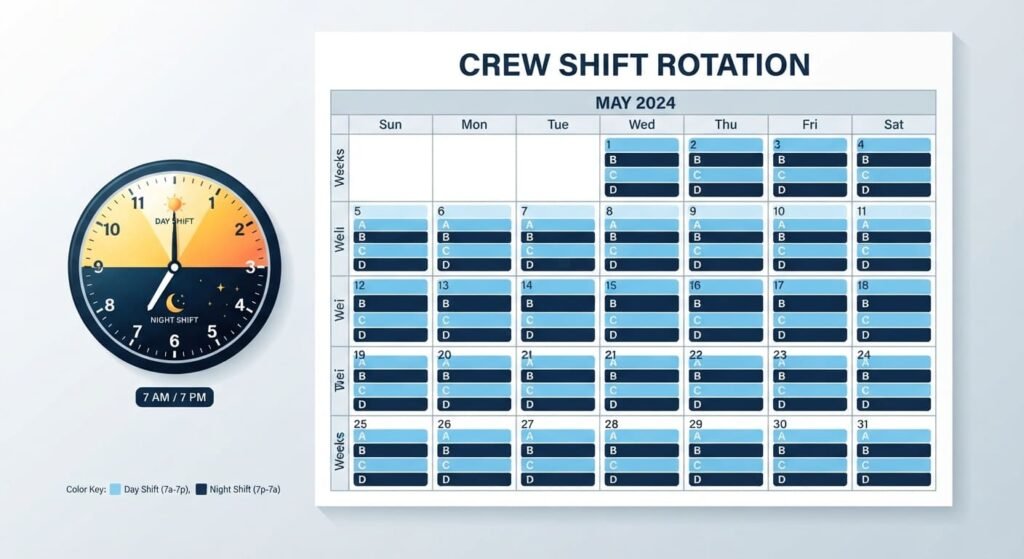
A 12 hour shift schedule splits the day into two shifts, usually 7 AM to 7 PM and 7 PM to 7 AM, and uses four crews to cover every hour of the week. The most common patterns are DuPont, 2-2-3 (also called Panama or Pitman), 4 on 4 off, and the three-shifts-a-week schedule used in hospitals. Most average 36 or 42 hours a week. This guide compares each 12 hour shift schedule, shows how the hours and overtime work, and explains how to build a rota for your team.
How a 12 hour shift schedule works
With 8-hour shifts, a 24/7 operation needs three handovers a day and at least four or five crews. With 12-hour shifts there are only two handovers, at the start and end of the day shift. Four crews take turns: on any given day one crew works days, one works nights and two are off. Each crew works about half the days of the year, but each working day is longer.
Start times vary. 7 to 7 is the most common, 6 to 6 is popular in manufacturing, and some hospitals use 7:30 to 7:30 to allow for handover.
Common 12 hour shift schedule patterns
| Pattern | Cycle | How it runs | Average hours a week |
|---|---|---|---|
| DuPont | 28 days | 4 nights, 3 off, 3 days, 1 off, 3 nights, 3 off, 4 days, 7 off | 42 |
| 2-2-3 (Panama / Pitman) | 14 days | Work 2, off 2, work 3, off 2, work 2, off 3 | 42 |
| 4 on, 4 off | 8 or 16 days | 4 shifts, 4 days off (fixed), or 4 days, 4 off, 4 nights, 4 off (rotating) | 42 |
| 3 on, 3 off | 6 days | 3 shifts, 3 days off | 42 |
| Three 12s (hospital) | 7 days | 3 shifts a week, days set by the roster | 36 |
| 4-3, 3-4 | 14 days | 4 shifts one week, 3 the next | 42 |
Every four-crew 12 hour shift schedule that covers 24/7 averages 42 hours a week, because 168 hours a week divided among four crews is 42 hours each. The patterns differ in how those hours are arranged.
The DuPont schedule
The DuPont schedule runs on a 28-day cycle: 4 nights, 3 days off, 3 day shifts, 1 day off, 3 nights, 3 days off, 4 day shifts, then 7 days off in a row. That week off every four weeks is its main attraction. The downsides are the stretches of 4 consecutive 12-hour shifts and the frequent switches between days and nights. Crews start the cycle a week apart, so on every day exactly one crew is on days and one on nights.
The 2-2-3 schedule (Panama or Pitman)
The 2-2-3 schedule repeats every two weeks: work 2 days, off 2, work 3, off 2, work 2, off 3. No one works more than three shifts in a row, and every other weekend is a three-day weekend. The names Panama and Pitman are used for the same 2-2-3 rhythm; the difference is usually whether crews work fixed days or nights, or rotate between them every few weeks.
In a fixed version, crews A and B work days and crews C and D work nights. In a rotating version, each crew works two weeks of days and then two weeks of nights.
4 on, 4 off
On a 4 on, 4 off 12 hour shift schedule, you work four shifts and then have four days off. The simplest version keeps crews on fixed days or nights. The rotating version runs 4 days, 4 off, 4 nights, 4 off over 16 days. It gives long breaks, but four 12-hour shifts in a row are tiring, and because the cycle is 8 days your days off move through the week.
Three 12-hour shifts a week (hospitals)
Many hospitals schedule nurses for three 12-hour shifts a week, 36 hours, which counts as full time at those employers. The shifts are usually 7 AM to 7 PM or 7 PM to 7 AM, chosen on a self-scheduling or manager roster rather than a fixed cycle. It gives four days off a week, but back-to-back shifts and night work are common.
Hours and overtime on a 12 hour shift schedule
US federal overtime is based on a fixed 7-day workweek, not on the average. On a 2-2-3 schedule, crews work 3 shifts in one week and 4 in the next, depending on where the pay week starts:
| Week | Shifts | Hours | Overtime |
|---|---|---|---|
| Week 1 | 3 | 36 | 0 |
| Week 2 | 4 | 48 | 8 |
| Two-week total | 7 | 84 | 8 |
At $25 an hour, the 48-hour week pays 40 × $25 + 8 × $37.50 = $1,300, and the 36-hour week $900, for $2,200 over the two weeks. Some states, including California, also require daily overtime for hours over 8 in a day unless an alternative workweek has been adopted, so a 12-hour shift there may include overtime every day. Hospitals can use a special 8 and 80 arrangement, which counts overtime over 8 hours a day or 80 hours in two weeks. Our guide to how to calculate time and a half explains the rules.
How many days a year?
At a 42-hour average, a crew works 42 × 52 ÷ 12 = 182 shifts a year, about half the days of the year. On a 36-hour hospital schedule it is 156 shifts. That compares with about 260 working days on a standard 8-hour, five-day week.
Breaks on 12-hour shifts
A typical 12-hour shift includes a 30-minute meal break and one or two shorter rest breaks, but the rules depend on the employer and the state. Our guide to breaks and rest between shifts covers the main rules, including California's meal break rules for shifts over 10 hours.
Pros and cons of a 12 hour shift schedule
| Advantages | Drawbacks |
|---|---|
| About half the days of the year off | Long days are tiring, especially in a row |
| Fewer commutes | Little time for anything else on working days |
| Only two handovers a day | Fatigue near the end of a shift can affect safety |
| Regular long weekends or full weeks off | Childcare is harder to arrange for 12-hour days |
| Same crew for the whole shift, better continuity | Overtime on top of 12-hour shifts adds up fast |
How to choose a pattern
- Want long breaks? DuPont gives 7 days off every four weeks.
- Want short runs of work? 2-2-3 never asks for more than 3 shifts in a row.
- Want predictable weekdays? Patterns built on 7 or 14 days, like 2-2-3, keep the same days off every fortnight. 8-day patterns, like 4 on 4 off, move your days off through the week.
- Prefer fixed days or nights? Choose a fixed 2-2-3 or fixed 4 on 4 off, and keep the same crews on nights.
Build your own 12 hour shift schedule
The shift schedule maker draws any of these patterns as a monthly calendar. Pick a pattern, the date crew A starts, and your day shift start time; it shows which crew works days or nights each day, the hours each crew works that month, and lets you print it or download 12 months as a CSV for a spreadsheet. To track the hours you actually work, use the time clock.
Example: two weeks on a 2-2-3 schedule
Here is one 14-day cycle of a fixed 2-2-3 12 hour shift schedule for the two day crews (D = 7 AM to 7 PM, off = –):
| Day | 1 | 2 | 3 | 4 | 5 | 6 | 7 | 8 | 9 | 10 | 11 | 12 | 13 | 14 |
|---|---|---|---|---|---|---|---|---|---|---|---|---|---|---|
| Crew A | D | D | – | – | D | D | D | – | – | D | D | – | – | – |
| Crew B | – | – | D | D | – | – | – | D | D | – | – | D | D | D |
Crews C and D follow the same pattern on nights, 7 PM to 7 AM. Together the four crews cover every hour, and each crew works 7 shifts every 14 days.
12-hour shifts compared with 8-hour shifts
| 12-hour shifts | 8-hour shifts | |
|---|---|---|
| Shifts per day | 2 | 3 |
| Crews for 24/7 | 4 | 4 or 5 |
| Days worked a year (about) | 182 | 260 or more |
| Handovers per day | 2 | 3 |
| Longest run of work | Usually 3 or 4 days | Usually 5 to 7 days |
| Time for life on a work day | Very little | A few hours |
Setting up a 12 hour shift schedule for a team
- Work out coverage: how many people you need on each day and each night.
- Count crews: 24/7 cover with one crew on each shift needs four crews of that size, plus relief for holidays and sickness.
- Pick a pattern: fixed or rotating days and nights, and how long people can work in a row.
- Set start times: 6 to 6 and 7 to 7 are the most common; allow 15 to 30 minutes for handover if needed.
- Budget overtime: with a fixed workweek, many patterns include overtime in some weeks.
- Plan leave cover: a fifth, relief crew or a pool of floaters keeps holidays from turning into forced overtime.
- Publish it early: print or share the calendar months ahead; the shift schedule maker exports 12 months as a CSV.
Five-crew schedules
Some operations add a fifth crew to a 12 hour shift schedule. Spreading 168 weekly hours across five crews brings the average down to about 33.6 hours, leaving room for training, holidays and sickness without overtime, or letting crews work some 8-hour days. It costs more in headcount but reduces fatigue and overtime.
Switching between days and nights
Rotating schedules move crews between day and night blocks. The hardest moment is the change itself: after a run of nights, the first day off is mostly spent recovering. Patterns that give at least two days off between a night block and a day block are easier to live with. When you finish a night block, a short sleep in the morning and an early night usually helps reset.
Family life on 12-hour shifts
Twelve-hour days make childcare and school runs harder on working days, but the long breaks give more full days at home. Families often plan around the calendar months ahead: printing the rota, matching days off with a partner's schedule and lining up childcare for the long days. A fixed pattern like 2-2-3 makes this easier because the same weekdays repeat every two weeks.
Hours over a year compared with 40-hour weeks
An average of 42 hours a week on a four-crew 12 hour shift schedule is 2,184 hours a year, 104 more than a standard 2,080-hour year. Those extra hours are usually paid at overtime rates in the weeks they fall into, which is one reason 12-hour rotations can pay well. A 36-hour hospital schedule is 1,872 hours a year, which those employers count as full time.
| Schedule | Shifts a year | Hours a year |
|---|---|---|
| Four-crew 24/7 (DuPont, 2-2-3, 4 on 4 off) | 182 | 2,184 |
| Three 12s a week | 156 | 1,872 |
| Five 8-hour days a week | 260 | 2,080 |
Choosing start times
The two most common 12 hour shift schedule start times are 6 AM and 7 AM. A 6 AM start gets day workers home by early evening, while 7 AM suits places that need staff for morning routines, such as hospitals. Many sites also overlap shifts by 15 to 30 minutes for handover. That overlap is paid time: 15 minutes on each of 182 shifts adds about 45 hours a year per person, so it belongs in the labor budget.
Nurse self-scheduling
Hospitals that use three 12-hour shifts a week often let nurses pick their own shifts within rules: a set number of weekend and night shifts per period, no more than three shifts in a row, and fair sharing of holidays. It gives more control than a fixed rotation, but the published schedule can still change at short notice. Keeping your own log with the time clock makes it easy to check hours and differentials at the end of each pay period.
Common mistakes when planning 12-hour shifts
- Ignoring the pay week: the same pattern can produce very different overtime depending on which day the workweek starts.
- No relief for leave: without spare capacity, holidays turn into forced overtime for everyone else.
- Too many nights in a row on rotating patterns, which builds fatigue.
- Forgetting handover time in the hours and pay calculations.
- Not publishing far enough ahead for staff to plan childcare and holidays.
Questions to ask before accepting a 12 hour shift schedule
- Fixed or rotating? Will you always work days or nights, or rotate, and how often?
- What is the exact pattern? Ask for a printed month so you can see your days off and longest run of shifts.
- How is overtime counted? Which day does the pay week start, and is there any daily overtime?
- Is handover time paid? Fifteen minutes on every shift adds up over a year.
- How does leave work? Do holidays come out of a 12-hour shift (12 hours of PTO) or a standard 8-hour day?
- Is there mandatory overtime? Can you be held over after a 12-hour shift, and how often?
- What are the breaks? Length of the meal break, and whether it is paid.
Getting these answers before you start makes a 12 hour shift schedule much easier to plan around, and it avoids surprises on your first pay stub.
If your site still runs 8-hour shifts, see 1st, 2nd and 3rd shift hours. For the other shift types you may see on a rota, read types of work shifts, and if nights pay extra, the shift differential guide shows how it changes each week's pay, including the alternating overtime weeks.
Summary
A 12 hour shift schedule uses four crews and two shifts a day to cover 24/7 with an average of 42 hours a week, or 36 for the common hospital schedule. DuPont offers a week off every month, 2-2-3 keeps runs of work short, and 4 on 4 off gives long breaks. Check how your employer counts overtime, plan breaks and sleep carefully, and use the schedule maker to see your days at a glance.
Frequently asked questions
What is the most common 12 hour shift schedule?
The 2-2-3 (Panama or Pitman) schedule and DuPont are the most common rotating patterns in 24/7 operations. Hospitals often use three 12-hour shifts a week.
How many hours a week is a 12 hour shift schedule?
Four-crew 24/7 patterns average 42 hours a week. Three 12-hour shifts a week is 36 hours.
What is the DuPont schedule?
A 28-day 12-hour rotation: 4 nights, 3 off, 3 days, 1 off, 3 nights, 3 off, 4 days, then 7 days off.
Do you get overtime on 12-hour shifts?
Under US federal law, overtime is due for hours over 40 in a workweek, so weeks with four 12-hour shifts (48 hours) include 8 overtime hours. Some states also have daily overtime rules.
How many 12-hour shifts is full time?
Usually three a week (36 hours) in hospitals, or an average of 3.5 a week (42 hours) on four-crew 24/7 patterns.
By the TimeNowTools team · Last reviewed 27 October 2026