Shift Differential: What It Is and How to Calculate It
Extra pay for evening, night and weekend hours: how it is calculated, how it affects overtime, and what the law requires.
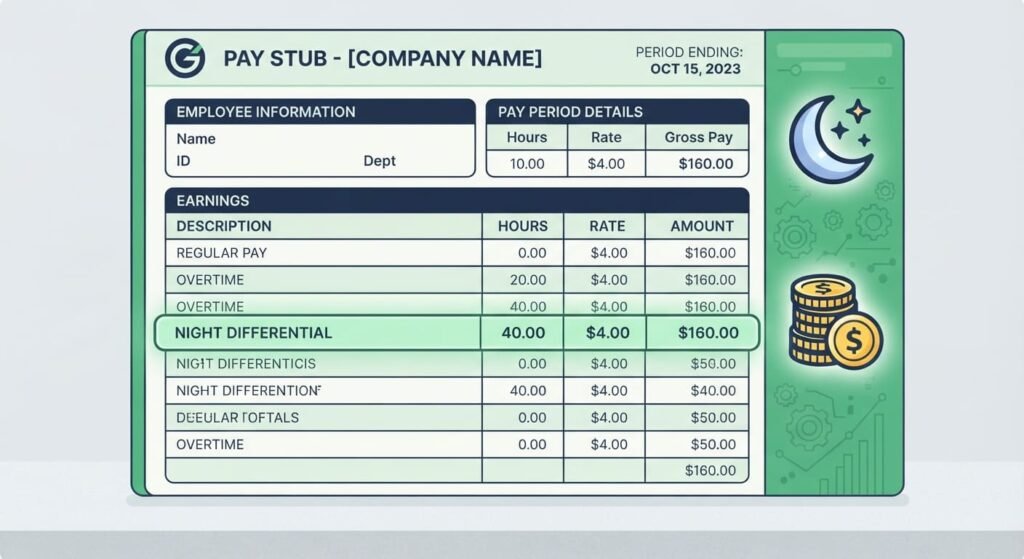
A shift differential is extra pay for working less desirable hours, usually evenings, nights or weekends. Employers pay it as a flat amount per hour, such as $2 more an hour, or as a percentage of your base rate, such as 10%. If your base rate is $20 and the night differential is 10%, you earn $22 for each night hour. This guide explains how a shift differential works, how to calculate it, how it affects overtime, and what the law does and doesn't require.
What a shift differential is for
Evening and night work disrupts sleep, family time and social life, and weekend work takes away the days most people have off. A differential compensates for that and helps employers fill the hours that are hardest to staff. It is common in hospitals, manufacturing, warehouses, call centres, security and utilities, anywhere that runs around the clock.
Types of shift differential
| Type | When it applies | Example |
|---|---|---|
| Evening (2nd shift) | Afternoon and evening hours, such as 3 PM to 11 PM | $1.00 an hour extra |
| Night (3rd shift) | Overnight hours, such as 11 PM to 7 AM | $2.00 an hour or 10% extra |
| Weekend | Saturday and Sunday, sometimes Friday night | $1.50 an hour extra |
| Holiday premium | Public holidays | Often time and a half or double time |
| On-call or call-back | Being available, or called in outside your shift | A set amount per shift, or a minimum number of paid hours |
The amounts above are examples only. Each employer, union contract or pay scale sets its own rates, and some stack them, so a Saturday night can attract both a night and a weekend differential.
How to calculate a shift differential
Flat amount per hour
Add the differential to your base rate. With a base of $18 and a $1.50 night differential, the night rate is $19.50. Eight night hours earn 8 × $19.50 = $156, which is $12 more than at the base rate.
Percentage of the base rate
Multiply your base rate by 1 plus the percentage. With a base of $24 and a 10% differential, the rate is $24 × 1.10 = $26.40. A 12-hour night shift pays 12 × $26.40 = $316.80, which is $28.80 more than at the base rate.
Only some hours qualify
Many policies apply the differential only to hours inside a time window, for example 6 PM to 6 AM. If you work 2 PM to 10:30 PM with a 30-minute unpaid break, and the window starts at 6 PM, then 4.5 of your 8 paid hours qualify (assuming the break falls before 6 PM). Other employers pay the differential for the whole shift if most of it falls in the window. Check your policy for the exact rule.
Worked example: a week of nights
Sam earns $22 an hour with a 10% night differential, so the night rate is $24.20. This week Sam works three 8-hour night shifts and two 8-hour day shifts:
- Night hours: 24 × $24.20 = $580.80
- Day hours: 16 × $22.00 = $352.00
- Total: 40 hours, $932.80
The differential added $52.80 to the week, or about $2,746 over a year at the same schedule.
Shift differential and overtime
Under the US Fair Labor Standards Act, a differential is part of your regular rate of pay. Overtime must be calculated on that blended rate, not just your base rate. The method:
- Add up all straight-time pay for the week, including differentials.
- Divide by the total hours worked to get the regular rate.
- Pay an extra half of the regular rate for each hour over 40.
Example: $20 base, $2 night differential. You work 30 night hours and 15 day hours, 45 hours in total.
- Straight-time pay: 30 × $22 + 15 × $20 = $660 + $300 = $960
- Regular rate: $960 ÷ 45 = $21.33
- Overtime premium: 0.5 × $21.33 × 5 = $53.33
- Total for the week: $1,013.33
If overtime had been calculated on the $20 base rate alone, the premium would be $50, slightly underpaying. Some employers simply pay time and a half on whichever rate applied to each overtime hour, which can pay a little more. The shift differential calculator does the blended-rate method for you, and our guide to time and a half covers overtime in general.
Is a shift differential required by law?
Not under US federal law. The FLSA requires minimum wage and overtime, but it doesn't require extra pay for night, evening or weekend work. A differential comes from your employer's policy, a union contract or, for public employees, a government pay system. A few situations have their own rules; California's split-shift premium is one example. Outside the US, some countries require night or weekend premiums through law or collective agreements, so check the rules where you work.
Once an employer promises a differential in a policy or contract, it generally has to pay it as promised.
Shift differential, PTO and benefits
Whether paid time off, holiday pay or sick pay includes your differential varies. Some employers pay PTO at your base rate only, others at your usual blended rate. Retirement contributions may or may not be calculated on differential pay. These are policy choices, so read your handbook or ask HR. Our PTO guide explains how leave accrues.
Taxes
A differential is ordinary wages. It is taxed the same way as the rest of your pay and appears in your gross pay, often as a separate line on the pay stub, such as "Night diff" or "Shift premium".
Checking your shift differential on a pay stub
- Find the hours that qualified, usually listed separately from regular hours.
- Multiply them by the differential amount, or by your base rate × the percentage.
- If you worked over 40 hours, check that overtime was paid on the blended rate.
- Compare with your own record. The time clock keeps a log of your shifts.
Negotiating a shift differential
If you are offered evening, night or weekend work, it is reasonable to ask whether a differential applies, whether it covers the whole shift or only part of it, whether it is included in overtime and PTO, and whether it changes if you rotate to days. Get the answers in writing, especially for night roles where the differential is a big part of total pay.
Differential, overtime and premium pay compared
| What triggers it | Required by US federal law? | Typical form | |
|---|---|---|---|
| Shift differential | When you work (evenings, nights, weekends) | No | Extra $ per hour or a % |
| Overtime | How much you work (over 40 hours a week) | Yes, for non-exempt workers | 1.5 × the regular rate |
| Holiday premium | Working on a public holiday | No | Often 1.5× or 2× |
| Call-back or on-call pay | Being available or called in | Only if the time counts as work | Set amount or minimum hours |
Differentials for part of a shift
When the differential applies only inside a time window, count the qualifying hours. With a window from 6 PM to 6 AM:
| Shift | Hours worked | Hours in the window |
|---|---|---|
| 7 AM to 3 PM | 8 | 0 |
| 2 PM to 10 PM | 8 | 4 |
| 3 PM to 11 PM | 8 | 5 |
| 11 PM to 7 AM | 8 | 7 |
| 7 PM to 7 AM | 12 | 11 |
Unpaid breaks inside the window reduce the qualifying hours. Some employers instead pay the extra rate for the whole shift if at least half of it falls in the window, which is simpler to administer.
What a differential is worth over a year
Small hourly amounts add up. For a full-time schedule of 2,080 hours, with every hour qualifying:
| Extra per hour | Per week (40 h) | Per year |
|---|---|---|
| $0.50 | $20 | $1,040 |
| $1.00 | $40 | $2,080 |
| $1.50 | $60 | $3,120 |
| $2.00 | $80 | $4,160 |
| $3.00 | $120 | $6,240 |
A 10% differential on a $25 base is $2.50 an hour, or $5,200 over a full-time year.
Salaried employees
Exempt salaried employees don't earn overtime, but some employers still pay them a night or weekend stipend, for example a fixed amount per night shift. For non-exempt salaried employees, any differential paid must be included in the regular rate when overtime is calculated, just as for hourly workers.
Reading differentials in a job offer
Offers often list several premiums in shorthand, for example "$24/hr + $2 nights + $1.50 weekends". Ask:
- Do the night and weekend amounts stack on a Saturday night?
- Which hours count as "nights": the whole shift or a time window?
- Is the extra pay included when overtime is calculated?
- Is it paid on holidays, PTO and training days?
- Does it stop if you move to day shift?
Common mistakes
- Calculating overtime on the base rate only, which underpays when a differential applies.
- Applying a percentage to the wrong rate, such as an already-increased weekend rate, when the policy says base rate.
- Counting the whole shift when only hours inside a window qualify, or the other way round.
- Forgetting unpaid breaks that fall inside the differential window.
Where differentials are common
- Hospitals and nursing: evening, night and weekend differentials are standard in many hospitals, sometimes alongside extra pay for charge duties or being on call.
- Manufacturing: 2nd and 3rd shift workers often receive a set amount per hour above the day rate.
- Warehouses and distribution: night and weekend shifts commonly carry a premium, especially during peak seasons.
- Call centres and IT support: overnight and weekend cover is often paid at a higher rate.
- Security and utilities: round-the-clock operations frequently pay extra for nights and weekends.
Amounts vary widely between employers and regions, so compare actual offers rather than assuming a typical rate.
How employers set the amount
Employers weigh how hard the hours are to fill, what competitors pay, union agreements and their budget. Where a night shift is consistently short-staffed, the differential tends to rise; where many people want evening work, it may be small or absent. In unionised workplaces the amounts are usually set in the collective agreement and apply to everyone in the bargaining unit.
Differentials on 12-hour shifts
On a 12-hour night rotation, most or all hours usually qualify. Take a $30 base rate and a $3 night differential, on a 2-2-3 schedule where crews alternate 36-hour and 48-hour weeks:
- 48-hour week, all nights: straight time 48 × $33 = $1,584; regular rate $33; overtime premium 0.5 × $33 × 8 = $132; total $1,716.
- 36-hour week, all nights: 36 × $33 = $1,188, no overtime.
Over the two weeks that is $2,904, of which $252 comes from the differential itself and $12 from its effect on overtime. See our 12-hour shift schedules guide for how the weeks fall.
Tracking qualifying hours
Because only some hours may qualify, keep a log of your start and end times and note which hours fall in the differential window. The time clock records each shift in your browser and exports a spreadsheet, and the hours calculator totals a week of shifts, including overnight ones.
A differential or a higher base rate?
When comparing jobs, a higher base rate and a differential are not the same thing. A base rate applies to every hour, counts toward PTO and raises, and stays if you move to days. A differential applies only to qualifying hours and usually stops when you change shifts.
Example: two night jobs, 36 hours a week. Offer A pays $23 an hour plus a $2 night differential. Offer B pays $24.50 with no differential.
- On nights, offer A pays 36 × $25 = $900 a week; offer B pays 36 × $24.50 = $882. Offer A is $18 a week better.
- If you later move to days, offer A drops to 36 × $23 = $828; offer B stays at $882.
- If PTO is paid at the base rate only, offer B also pays more for every day of leave.
So the right choice depends on how long you plan to stay on nights and how your employer pays leave. Run both offers through the calculator with your expected hours.
Night and Sunday premiums for US federal employees
Federal government workers are one group where premiums are set by law rather than by each employer. Under the federal pay rules, employees on the General Schedule who are regularly scheduled to work at night, between 6 PM and 6 AM, receive a night differential of 10% of their basic pay for those hours. Those regularly scheduled to work on a Sunday receive a Sunday premium of 25% of basic pay for that work. Federal wage-system (hourly trades) employees have their own night shift rates. State and local governments set their own rules, often in union contracts.
Quick checklist
- Find out whether the differential is a flat amount or a percentage, and of which rate.
- Check which hours qualify: the whole shift or a time window.
- Multiply the qualifying hours by the extra rate.
- For weeks over 40 hours, recalculate overtime on the blended regular rate.
- Check how PTO and holidays are paid.
Key points
- A shift differential is extra pay for evening, night or weekend hours, set by your employer, contract or pay system.
- It can be a flat amount per hour or a percentage of your base rate.
- Check which hours qualify: the whole shift, or only hours inside a time window.
- Under the FLSA it is part of the regular rate, so it raises your overtime rate too.
- Ask whether PTO, holidays and training days include it.
For when evening and night shifts usually start and end, see 1st, 2nd and 3rd shift hours, and for the rules on rest between them, how many hours between shifts.
Summary
A differential adds a flat amount or a percentage to your base rate for evening, night or weekend hours. Multiply the differential rate by the qualifying hours to find the extra pay, include it in the regular rate when you work overtime, and check your employer's policy for which hours qualify. To see the numbers for your own schedule, use the shift differential calculator.
Frequently asked questions
What is a shift differential?
Extra pay for working evening, night or weekend hours, paid as a flat amount per hour or a percentage of your base rate.
How do you calculate a 10% shift differential?
Multiply your base rate by 1.10. A $20 base becomes $22 an hour for the qualifying hours.
Is shift differential included in overtime?
Yes, under the US FLSA. It is part of the regular rate, so overtime is 1.5 times the blended rate.
Is shift differential required by law?
Not under US federal law. It comes from employer policy, union contracts or public pay systems.
How much is a $2 night differential worth in a year?
About $4,160 for a full-time schedule of 2,080 hours, if every hour qualifies.
Is a shift differential taxed?
Yes. It is ordinary wages, taxed the same way as the rest of your pay, and usually shown as a separate line on your pay stub.
By the TimeNowTools team · Last reviewed 27 October 2026