Types of Work Shifts Explained: Day, Swing, Graveyard and More
Day, swing, graveyard, NOC, rotating, split, double, on-call and per diem shifts, with typical hours and where each is used.
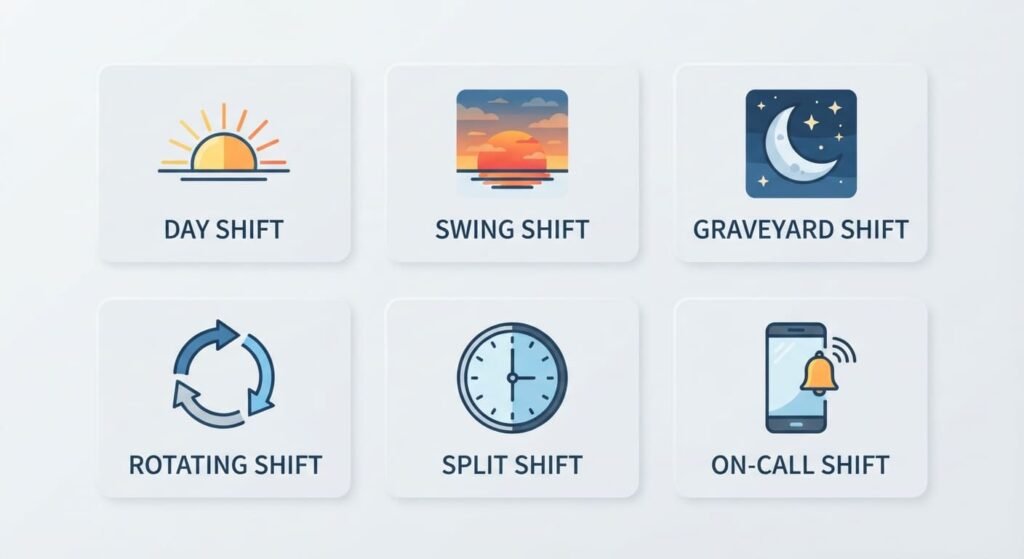
The main types of work shifts are day, evening (swing), night (graveyard) and rotating shifts, plus special arrangements such as split shifts, double shifts, on-call shifts and compressed weeks. Each one describes when you work and how the schedule repeats. This guide explains every common type, with typical hours, the industries that use it, and the pay and lifestyle trade-offs, so you can read a job ad or a rota with confidence.
Types of work shifts at a glance
| Shift type | Typical hours | Common in |
|---|---|---|
| Day shift (1st shift) | 7 AM to 3 PM, 9 AM to 5 PM | Offices, factories, schools, retail |
| Swing shift (2nd shift) | 3 PM to 11 PM | Factories, warehouses, hospitals, security |
| Graveyard shift (3rd shift) | 11 PM to 7 AM | Hospitals, factories, security, logistics |
| NOC shift | 11 PM to 7 AM, or 7 PM to 7 AM | Nursing and care homes |
| 12-hour shift | 7 AM to 7 PM, 7 PM to 7 AM | Hospitals, police, fire, continuous plants |
| Rotating shift | Changes on a set cycle | 24/7 operations |
| Split shift | Two blocks, for example 6 to 10 AM and 3 to 7 PM | Restaurants, transit, school buses, care work |
| Double shift | Two shifts back to back, about 16 hours | Hospitality, healthcare, manufacturing |
| On-call shift | Available to work if called | Healthcare, IT support, utilities |
| Per diem shift | Booked as needed | Nursing, therapy, staffing agencies |
| Compressed week | 4 × 10 hours, or 9/80 | Offices, government, manufacturing |
Fixed shifts and rotating shifts
Before looking at individual types of work shifts, it helps to separate two big groups. On a fixed shift you always work the same hours, for example every weekday 3 PM to 11 PM. On a rotating shift your hours change on a set cycle: a week of days, then a week of evenings, then a week of nights, or two weeks of days followed by two weeks of nights. Fixed shifts are easier on sleep and family life; rotating shifts share the unpopular hours fairly across a team.
Day shift (1st shift)
The day shift is the standard working day. In a three-shift operation it usually runs 7 AM to 3 PM or 6 AM to 2 PM; in a single-shift office it is often 9 AM to 5 PM. It has the most normal routine and the most competition for jobs. See the 1st, 2nd and 3rd shift hours guide for the exact times by industry.
Swing shift (2nd shift)
A swing shift is the evening shift between day and night, typically 3 PM to 11 PM. The name comes from the way it "swings" between the other two shifts. It suits people who prefer late mornings, and it often pays a small shift differential. In a few workplaces "swing shift" instead means a rotating schedule, which is a good example of why the types of work shifts are worth checking in each job ad rather than assuming.
Graveyard shift (3rd shift)
The graveyard shift is the overnight shift, usually 11 PM to 7 AM or 10 PM to 6 AM. Nobody is sure where the name comes from; the most likely explanation is simply that the hours are quiet as a graveyard. It usually carries the highest pay differential of the three, but working against the body clock makes it the hardest shift to sustain. Keeping the same sleep schedule on days off helps.
NOC shift (nursing)
NOC is short for nocturnal and is used mainly in nursing and long-term care. A NOC shift is the night shift: 11 PM to 7 AM in facilities with 8-hour shifts, or 7 PM to 7 AM where nurses work 12-hour shifts. NOC nurses look after patients overnight: medication rounds, monitoring, admissions and handover to the day team.
12-hour shifts
Many 24/7 workplaces replace three 8-hour shifts with two 12-hour shifts, usually 7 AM to 7 PM and 7 PM to 7 AM. Staff work fewer, longer days: three or four shifts a week instead of five. Hospitals commonly use three 12-hour shifts a week (36 hours) for full-time nurses, while factories and emergency services use rotating patterns such as DuPont or 2-2-3. Our 12-hour shift schedules guide compares them, and the shift schedule maker draws the calendar for your crew.
Rotating shifts
A rotating shift moves you between day, evening and night work, or between days and nights, on a repeating cycle. Common patterns are:
- Weekly rotation: one week of days, one of evenings, one of nights.
- DuPont: a 28-day 12-hour cycle with a full week off every four weeks.
- 2-2-3 (Panama or Pitman): work 2 days, off 2, work 3, then the reverse.
- 4 on, 4 off: four 12-hour shifts, then four days off.
Rotating schedules share nights and weekends fairly, but frequent changes between days and nights disrupt sleep. Forward rotation (days, then evenings, then nights) is generally considered easier to adjust to than backward rotation.
Split shifts
A split shift divides one working day into two parts with an unpaid gap, for example 6 AM to 10 AM and 3 PM to 7 PM. Restaurants use it to cover lunch and dinner rushes, and transit and school bus services use it for morning and afternoon peaks. The gap is not paid, but some places add a premium. California, for example, requires a split shift premium of one hour's pay at the minimum wage in many cases, unless the employee already earns enough above the minimum to cover it. The time between the blocks doesn't count as hours worked unless you must stay on site.
Double shifts
A double shift means working two shifts back to back, for example a day shift followed by an evening shift, about 16 hours in total. It is common in restaurants and hospitals when someone calls in sick. All the hours count toward the week, so a double shift can push you into overtime: two 8-hour shifts in a 40-hour week leave fewer hours before time and a half starts.
On-call shifts
On an on-call shift you must be available to work if needed. Whether the waiting time is paid depends on how restricted you are. Under US federal rules, if you must stay at the workplace or are so restricted that you can't use the time for yourself, it counts as work. If you can stay home and simply answer the phone, usually only the time actually spent working is paid, although many employers pay an on-call allowance.
Per diem shifts
Per diem means "per day". Per diem workers, common in nursing and therapy, pick up individual shifts when they are needed instead of holding a fixed schedule. They usually earn a higher hourly rate but have no guaranteed hours and often fewer benefits.
Compressed and flexible schedules
- 4/10: four 10-hour days, for example 7 AM to 5:30 PM with a 30-minute break, and a three-day weekend every week.
- 9/80: 80 hours over nine working days in two weeks, with every other Friday off.
- Flextime: fixed core hours, such as 10 AM to 3 PM, with flexible start and finish times.
Compressed weeks keep the total hours but change their shape. The work shift hours chart lists the hours for each.
Other terms you may see
- Clopening: closing late and opening early the next day, with little rest in between. Some US cities limit it; see rest between shifts.
- Weekend shift: Friday to Sunday or Saturday and Sunday only, often longer shifts with a weekend differential.
- Overtime shift: an extra shift beyond your normal schedule, usually paid at time and a half if it takes you over 40 hours in the week.
- Relief or floater: covers other people's shifts and breaks across teams.
Pay differences between types of work shifts
Evening, night, weekend and split shifts often pay more than day shifts through a shift differential or premium. Whether you get one, and how much, depends on your employer, contract and location; US federal law doesn't require it. Our shift differential guide explains how it is calculated, and the shift differential calculator shows the effect on a week's pay, including overtime.
Choosing between types of work shifts
| If you value | Consider |
|---|---|
| A regular routine and evenings at home | Fixed day shift |
| Free mornings and a shorter commute | Fixed swing shift |
| The highest hourly pay | Night shift with a differential |
| Fewer days at work | 12-hour shifts or a 4/10 week |
| Flexibility to choose when you work | Per diem or flextime |
Whatever you choose, the types of work shifts that suit you best are the ones you can sleep, eat and plan around consistently.
Mid shifts, opening and closing shifts
Retail, restaurants and call centres often describe shifts by their position in the business day rather than by number:
- Opening shift: starts before the doors open, for example 6 AM to 2 PM, to set up, stock and prepare.
- Mid shift: overlaps the busiest hours, for example 11 AM to 7 PM, to cover lunch and the early evening.
- Closing shift: ends after the doors close, for example 3 PM to 11 PM, to clean, count and lock up.
These names are another of the common types of work shifts you will see on retail and hospitality rotas, and they sit on top of the 1st, 2nd and 3rd shift idea rather than replacing it.
Types of work shifts by industry
| Industry | Typical shift types |
|---|---|
| Hospitals and nursing | 12-hour days and nights (NOC), 8-hour 1st/2nd/3rd shifts, on-call, per diem |
| Manufacturing | Three 8-hour shifts, or 12-hour rotating shifts such as DuPont and 2-2-3 |
| Warehouses and logistics | Fixed day, evening and night shifts, weekend programs, peak-season overtime |
| Retail | Opening, mid and closing shifts, part-time and weekend shifts |
| Restaurants and hospitality | Split shifts, double shifts, closing shifts |
| Police, fire and emergency | 12-hour rotations, 24-hour shifts (fire), on-call |
| IT support and call centres | Staggered day and evening shifts, overnight cover, on-call rotations |
| Offices and government | Day shift, flextime, compressed weeks such as 4/10 and 9/80 |
24-hour shifts
Some firefighters and live-in carers work 24-hour shifts, followed by a longer break, such as 24 hours on and 48 hours off. Sleep time during a 24-hour shift may or may not be paid, depending on the job, the agreement and the law where you work. It is one of the less common types of work shifts, but it is standard in many fire departments.
How employers choose shift types
Employers pick shift types based on when work needs doing and how many people are needed at each hour. A business open 9 to 5 only needs a day shift. A hospital or factory that never stops needs either three 8-hour shifts or two 12-hour shifts, plus cover for holidays and sickness. Peaks, such as a restaurant's lunch and dinner rushes, lead to split or mid shifts. The shift schedule maker shows how four crews can cover 24 hours a day with 12-hour rotations.
Predictable scheduling rules
Several US cities and Oregon have predictive or fair workweek laws for large retail, food service and some hospitality employers. They typically require schedules to be posted in advance (commonly 14 days), pay a premium for last-minute changes, and guarantee rest between closing and opening shifts. If you work in a covered industry in one of these places, these rules apply whichever types of work shifts you are given. Our guide to breaks and rest between shifts covers the rest rules.
Staying healthy on non-day shifts
- Keep sleep regular: the same sleep window on workdays and days off makes evening and night work easier to sustain.
- Darken the bedroom and keep it quiet for daytime sleep.
- Time caffeine: use it early in the shift rather than in the last few hours.
- Plan meals: a main meal before work and lighter food during night hours.
- Get daylight on your days off when you can.
These are general habits, not medical advice. If shift work affects your health, talk to a doctor or occupational health service.
Describing your availability
When you apply for shift work, be specific about the types of work shifts you can do: for example "available 1st and 2nd shift, weekdays; nights on weekends only". Clear availability helps schedulers place you where you fit, and it makes later disagreements less likely.
Shift names in other countries
The same types of work shifts go by different names around the world. In the UK and Ireland, shift workers talk about early, late and night shifts, and in Scotland the late shift is often the back shift. In Australia and New Zealand the evening shift is usually the afternoon shift, and many awards and agreements define exactly which hours count as afternoon or night work for pay purposes. If you move between countries, check the hours behind each name.
Shift work and pay records
Whatever the shift type, keep your own record of the hours you work: start, end, breaks and any premium hours. It makes it easy to check a pay stub, especially when you work several types of work shifts in one week, such as a mix of days, closes and a double. The time clock records shifts in your browser and exports them as a spreadsheet.
Summary
The core types of work shifts are day, swing and graveyard, which divide the day into three 8-hour blocks. Twelve-hour and rotating shifts cover 24/7 operations with fewer handovers, while split, double, on-call and per diem shifts cover peaks and gaps. Check the exact hours, break policy and any differential before accepting a role, and use the hours calculator to total a week of any shift type.
Frequently asked questions
What are the main types of work shifts?
Day (1st), swing (2nd) and graveyard (3rd) shifts, plus 12-hour, rotating, split, double, on-call and per diem shifts, and compressed weeks such as 4/10.
What is a graveyard shift?
The overnight shift, usually 11 PM to 7 AM or 10 PM to 6 AM. It often pays a night differential.
What is a swing shift?
The evening shift between day and night, usually 3 PM to 11 PM. Some employers use the term for rotating schedules.
What does NOC shift mean?
NOC is short for nocturnal. In nursing it means the night shift, 11 PM to 7 AM or 7 PM to 7 AM.
How long is a double shift?
Two shifts back to back, usually about 16 hours with breaks. All the hours count toward weekly overtime.
What is a mid shift?
A shift in the middle of the business day, for example 11 AM to 7 PM, that overlaps the busiest hours between the opening and closing shifts.
By the TimeNowTools team · Last reviewed 27 October 2026