1st, 2nd and 3rd Shift Hours: What Time Each Shift Starts and Ends
Typical start and end times for 1st, 2nd and 3rd shift, how they vary by industry, and what each means for pay and daily life.
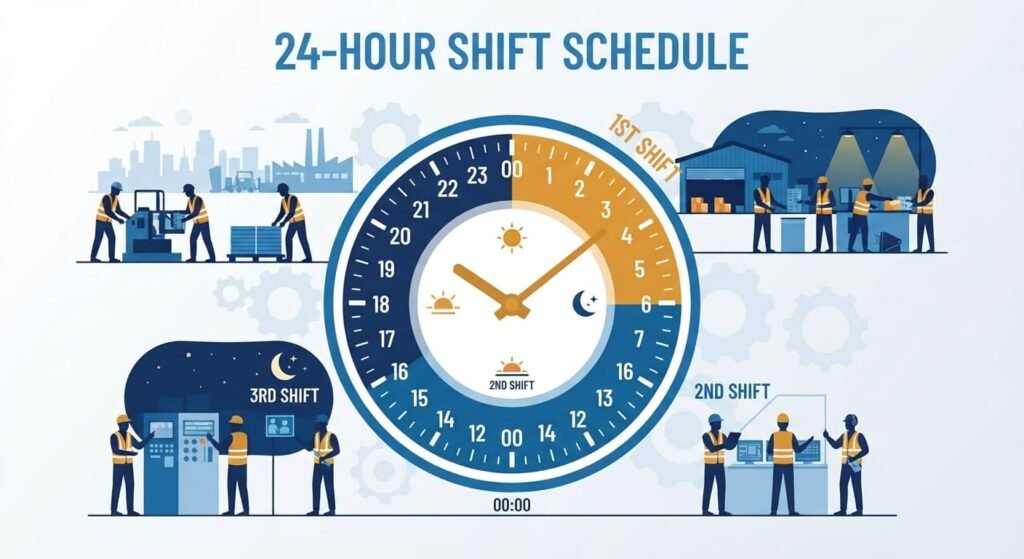
Typical 2nd shift hours are 3:00 PM to 11:00 PM. First shift usually runs from 7:00 AM to 3:00 PM, and third shift from 11:00 PM to 7:00 AM, so the three shifts cover the full 24 hours in 8-hour blocks. Employers can move each block by an hour or two, which is why one job lists 2nd shift as 2 PM to 10 PM and another as 4 PM to midnight. This guide explains the usual times for each shift, the other names they go by, how the hours change by industry, and what each shift means for pay, sleep and daily life.
1st, 2nd and 3rd shift hours at a glance
| Shift | Also called | Typical hours | Common variations |
|---|---|---|---|
| 1st shift | Day shift, first shift | 7:00 AM to 3:00 PM | 6 AM to 2 PM, 8 AM to 4 PM, 9 AM to 5 PM |
| 2nd shift | Second shift, evening shift, swing shift | 3:00 PM to 11:00 PM | 2 PM to 10 PM, 4 PM to 12 AM, 3:30 PM to 12 AM |
| 3rd shift | Third shift, night shift, graveyard shift, NOC shift | 11:00 PM to 7:00 AM | 10 PM to 6 AM, 12 AM to 8 AM |
There is no law that sets these times. They are a convention, built around the idea of three equal 8-hour shifts that keep a factory, hospital or warehouse running around the clock. Always check the exact times in the job listing or your contract.
What is 1st shift?
First shift is the daytime shift, and it is the closest to a normal working day. The most common 1st shift hours are 7 AM to 3 PM, but 6 AM to 2 PM is popular in manufacturing and 8 AM to 4 PM in warehouses and offices. In businesses that only run one shift, the whole working day is first shift, so a 9 to 5 office job is first shift too. Our work shift hours chart shows the hours for every common daytime shift.
First shift usually has the most applicants, because it fits school runs, family meals and daylight. It often starts early, though, so a 6 AM start can mean leaving home before 5:30.
What is 2nd shift, and what are 2nd shift hours?
Second shift starts when first shift ends and finishes around midnight. The standard 2nd shift hours are 3 PM to 11 PM, which gives an 8-hour shift with a 30-minute meal break in the middle of the evening. Common alternatives are 2 PM to 10 PM, 3:30 PM to midnight and 4 PM to 12:30 AM.
People also call it the evening shift or swing shift. "Swing shift" comes from the idea that it swings between the day and night shifts. In some workplaces, though, swing shift means a rotating schedule instead, so read the job description carefully.
Why 2nd shift hours vary
- Shift handover: plants often overlap shifts by 15 to 30 minutes so the outgoing team can brief the incoming team. That makes 2nd shift hours something like 2:45 PM to 11:15 PM.
- Paid or unpaid breaks: with an unpaid 30-minute meal break, an 8-hour paid shift needs 8.5 hours on site, for example 3 PM to 11:30 PM.
- Business hours: retail and restaurants set second shift around closing time, so 2nd shift hours may be 4 PM to close.
- Four-day weeks: a 10-hour 2nd shift might run 3 PM to 1:30 AM, four days a week.
What is 3rd shift?
Third shift is the overnight shift. The usual 3rd shift hours are 11 PM to 7 AM, with 10 PM to 6 AM and midnight to 8 AM as common alternatives. It is also called the night shift or graveyard shift, and in nursing the NOC shift (short for nocturnal). Third shift starts on one calendar day and ends on the next, which matters for timesheets: a shift that starts at 11 PM on Monday and ends at 7 AM on Tuesday is usually recorded as Monday's shift.
To count the hours of a shift that crosses midnight, add the hours before midnight to the hours after it: 11 PM to midnight is 1 hour, midnight to 7 AM is 7 hours, so the shift is 8 hours. The hours calculator handles overnight shifts automatically.
2nd shift hours by industry
The table shows typical 2nd shift hours, and the matching first and third shifts, in the industries that use them most. These are common patterns, not rules; individual employers set their own times.
| Industry | 1st shift | 2nd shift | 3rd shift |
|---|---|---|---|
| Manufacturing | 6 AM to 2:30 PM | 2:30 PM to 11 PM | 10:30 PM to 7 AM |
| Warehouses and distribution | 7 AM to 3:30 PM | 3:30 PM to 12 AM | 11 PM to 7:30 AM |
| Hospitals (8-hour shifts) | 7 AM to 3 PM | 3 PM to 11 PM | 11 PM to 7 AM |
| Hospitals (12-hour shifts) | 7 AM to 7 PM | (no 2nd shift) | 7 PM to 7 AM |
| Call centres | 8 AM to 4:30 PM | 4 PM to 12:30 AM | 12 AM to 8:30 AM |
| Retail and restaurants | Opening, about 6 AM to 2 PM | Closing, about 2 PM to 10 PM or close | Overnight stocking, about 10 PM to 6 AM |
Where a workplace switches to 12-hour shifts, the three-shift system becomes two: days and nights. Our guide to 12-hour shift schedules explains how those rotas work.
How many hours is each shift?
Each of the three classic shifts is 8 hours on paper. What you are paid for depends on the break policy:
- Paid meal break: 8 hours on site, 8 hours paid. Common in hospitals and continuous-process plants, where staff stay available during the break.
- Unpaid 30-minute meal break: 8.5 hours on site for 8 hours paid, or 8 hours on site for 7.5 hours paid.
- Short rest breaks: 5 to 20 minutes, usually paid in the US.
Over a five-day week, any of the three shifts gives 40 paid hours, or 37.5 with unpaid meal breaks taken out of an 8-hour day. Our guide on how to calculate work hours walks through the arithmetic step by step.
Do 2nd and 3rd shifts pay more?
Often, yes. Many employers add a shift differential for evening and night work: an extra amount per hour, such as $1.50, or a percentage of the base rate, such as 10%. US federal law does not require it, so it depends on the employer, the union contract or the state. A differential that applies to every one of your 2nd shift hours adds up quickly: $1.50 extra for 40 hours is $60 a week, or about $3,120 a year.
The differential also counts toward overtime. Under the Fair Labor Standards Act it is part of your regular rate, so overtime is calculated on the higher, blended rate. Our shift differential guide shows the full method, and the shift differential calculator works out a week's pay.
Pros and cons of each shift
| Shift | Advantages | Drawbacks |
|---|---|---|
| 1st | Fits a normal social and family life; daylight after work; most management support on site | Early starts; rush-hour commutes; most competition for positions |
| 2nd | Free mornings for appointments, study or childcare; lighter commute; often a differential | Misses evenings with family and friends; late finish; dinner at work |
| 3rd | Usually the highest differential; quieter workplace; daytime free for errands | Sleeping against the body clock; less daylight; hardest on health and family time |
Living with 2nd shift hours
Second shift suits people who are not morning people, students with daytime classes and parents who share childcare. A few habits make 2nd shift hours easier to sustain:
- Keep a fixed sleep window, for example 1 AM to 9 AM, including on days off. A regular schedule matters more than the exact times.
- Eat your main meal before work and a lighter meal on your break, so you are not eating heavily at midnight.
- Protect your mornings for the things you can't do in the evening: errands, exercise, family time.
- Plan social time around days off, since evening events overlap with your shift.
Reading shift times in a job listing
Job ads usually state the shift by number and then give the hours, for example "2nd shift (3:00 PM to 11:30 PM), Monday to Friday, $1.50 shift differential". Look for four details: the start and end times, whether the meal break is paid, which days you work, and whether the shift is fixed or rotating. "Rotating shifts" means you move between first, second and third shift on a schedule; see our guide to types of work shifts for rotating, split and other patterns.
Converting shift times to the 24-hour clock
Many workplaces, especially hospitals and factories, write shift times on the 24-hour clock to avoid AM/PM mistakes:
- 1st shift: 07:00 to 15:00
- 2nd shift: 15:00 to 23:00
- 3rd shift: 23:00 to 07:00
The military time converter translates any time, and our AM vs PM guide explains why 12 AM is midnight.
Weekly and yearly hours on each shift
| Schedule | Example 2nd shift hours | Paid hours a week | Paid hours a year |
|---|---|---|---|
| 5 × 8 hours, paid meal | 3:00 PM to 11:00 PM | 40 | 2,080 |
| 5 × 8 hours, 30-min unpaid meal | 3:00 PM to 11:30 PM | 40 | 2,080 |
| 5 × 7.5 hours | 3:00 PM to 11:00 PM, unpaid meal | 37.5 | 1,950 |
| 4 × 10 hours | 3:00 PM to 1:30 AM | 40 | 2,080 |
| Part time, 4 hours | 5:00 PM to 9:00 PM | 20 | 1,040 |
The same arithmetic applies to first and third shift. What changes the totals is the meal break policy and the number of days, not the shift number.
Weekend and part-time 2nd shift hours
Not every second shift is a full 8 hours on weekdays. Part-time 2nd shift hours are often 4 to 6 hours, such as 5 PM to 9 PM in retail or 4 PM to 10 PM in warehouses at peak season. Weekend programs, sometimes called a weekend shift or baylor shift, pack the week into two or three long days, for example Friday to Sunday 12-hour shifts. If you combine a part-time evening job with a day job, add the hours of both to see your true working week.
A typical day on 2nd shift
Here is how a common 3 PM to 11 PM schedule can fit together:
| 9:00 AM | Wake up, breakfast |
| 10:00 AM to 1:00 PM | Errands, exercise, appointments or study |
| 1:30 PM | Main meal |
| 2:30 PM | Leave for work |
| 3:00 PM to 11:00 PM | Shift, with a meal break around 7 PM |
| 11:45 PM | Home, light snack, wind down |
| 1:00 AM | Sleep |
The key is consistency: going to bed and waking up at the same times on workdays and days off keeps 2nd shift hours from drifting into broken sleep.
Pay on each shift: an example
Take a $20 base rate, a $1.00 evening differential and a $2.00 night differential, for 40 hours a week:
| Shift | Hourly | Weekly | Yearly |
|---|---|---|---|
| 1st shift | $20.00 | $800 | $41,600 |
| 2nd shift | $21.00 | $840 | $43,680 |
| 3rd shift | $22.00 | $880 | $45,760 |
Differentials vary widely between employers, so use your own figures in the shift differential calculator.
Switching from 1st shift to 2nd or 3rd shift
- Move your sleep gradually. Shift bedtime and wake-up later by an hour or two a day in the days before the change.
- Use light deliberately. Bright light at the start of your shift and darkness when you sleep help your body clock adjust.
- Plan the first week. Expect to feel tired for a few days; avoid scheduling demanding tasks right after your first late shifts.
- Tell the people you live with your new sleep hours, so mornings stay quiet.
What "1st shift preferred" or "2nd shift only" means in a job ad
"1st shift preferred" usually means the employer will consider you for other shifts but hopes you can work days. "2nd shift only" means the role is fixed on second shift. "All shifts" or "rotating" means you may be scheduled on any of the three. If the listing doesn't state exact 2nd shift hours, ask before the interview, because a 2 PM and a 4 PM start make a big difference to your day.
Shift names outside the US
The numbered 1st, 2nd and 3rd shifts are mostly an American way of speaking. Elsewhere the same hours have other names:
| US name | UK and Ireland | Australia and New Zealand |
|---|---|---|
| 1st shift | Early shift, day shift | Day shift, morning shift |
| 2nd shift | Late shift, back shift (Scotland) | Afternoon shift |
| 3rd shift | Night shift | Night shift |
A UK "late shift" in a hospital or shop often runs about 2 PM to 10 PM, which is close to US 2nd shift hours. If you are applying for a job abroad, check the times rather than relying on the name.
Overtime on later shifts
Evening and night shifts are where overtime often appears, because they are the hardest to staff. Overtime rules don't depend on the shift: under US federal law it is due for hours over 40 in the workweek, whether you work 1st, 2nd or 3rd shift. If you earn a differential on your 2nd shift hours, it also raises your overtime rate, as explained in the shift differential guide. Our guide to time and a half shows the full calculation.
For the rest you are entitled to between a late shift and an early one, and the breaks during each shift, see how many hours between shifts.
Summary
First shift covers the morning and early afternoon, roughly 7 AM to 3 PM. Standard 2nd shift hours run from about 3 PM to 11 PM, and third shift covers the night, about 11 PM to 7 AM. Exact times vary by employer, so check the listing, and remember that later shifts often come with a pay differential. If you work rotating or 12-hour shifts, the shift schedule maker shows your days and nights on a calendar.
Frequently asked questions
What time is 2nd shift?
Usually 3 PM to 11 PM. Some employers use 2 PM to 10 PM or 4 PM to midnight, so check the job listing for the exact 2nd shift hours.
What are 3rd shift hours?
Typically 11 PM to 7 AM, sometimes 10 PM to 6 AM or midnight to 8 AM. It is also called the night or graveyard shift.
What is 1st shift?
The day shift, usually 7 AM to 3 PM, or 6 AM to 2 PM in many factories.
Is 2nd shift the same as swing shift?
Usually yes. Swing shift normally means the evening shift between day and night, but some employers use it for rotating schedules.
Does 2nd shift pay more than 1st shift?
Often. Many employers pay a shift differential for evening and night hours, but it is not required by US federal law.
What are 2nd shift hours on a 4-day week?
Usually four 10-hour shifts, for example 3 PM to 1:30 AM with a 30-minute unpaid meal break, for 40 hours a week.
By the TimeNowTools team · Last reviewed 27 October 2026